Your engineering team in San Francisco logs off at 5 PM. Your team in Bangalore picks up the work at 6 AM their time. By the time California wakes up, the feature is tested and ready for review. No overnight shifts. No waiting 24 hours for a response. Just continuous progress around the clock.
A follow the sun workflow distributes work across [time zones](https://en.wikipedia.org/wiki/Time_zone) so your team delivers continuously without requiring anyone to work night shifts. Success depends on clear handoff protocols, comprehensive documentation, and tools that support asynchronous collaboration. When implemented correctly, teams reduce delivery time by 30-50% while improving work-life balance across all locations.
What a follow the sun workflow actually means
A follow the sun workflow means structuring your team so work passes from one time zone to the next as the day progresses. When one location ends their workday, another location starts theirs and continues the work.
The name comes from the idea that you’re literally following the sun across the planet.
This differs from traditional distributed teams where everyone works their own hours but waits for responses. It also differs from on-call rotations where someone gets woken up at 3 AM.
Instead, you design workflows so handoffs happen during normal business hours for everyone involved.
A support team in New York handles customer tickets until 6 PM. Then Sydney takes over at their 9 AM. Then Singapore. Then London. Then back to New York. The customer never waits more than a few hours, and no one works overnight.
The same principle applies to engineering, operations, incident response, or any workflow that benefits from continuous progress.
Why engineering leaders are adopting this model
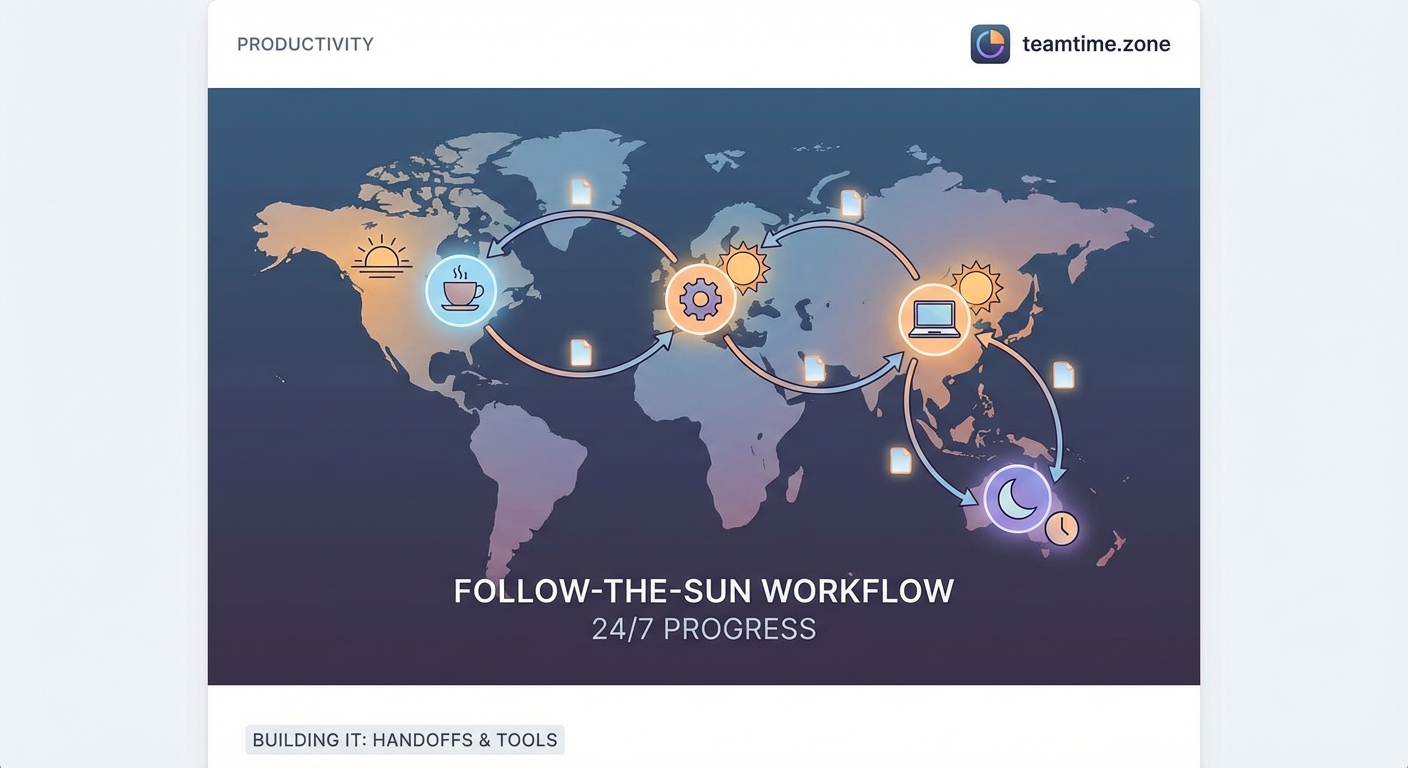
Traditional distributed teams face a simple math problem. If your team spans 12 time zones, you either accept 12-hour delays between responses, or you ask people to join meetings at midnight.
Neither option works well long-term.
A follow the sun workflow solves this by turning time zones into an advantage rather than an obstacle. Your delivery pipeline never stops. Features move forward every hour, not every day.
Here’s what changes:
- Bug fixes that used to take three days now take one day because three shifts work on them
- Customer issues get resolved faster because someone is always available during business hours
- Code reviews happen within hours instead of waiting until tomorrow
- Deployment windows expand because you have coverage across all time zones
The business case is straightforward. Faster delivery means faster feedback. Faster feedback means better products. Better products mean competitive advantage.
But the human case matters just as much. When handoffs work properly, people can actually disconnect after work. No more checking Slack at 10 PM because someone in another time zone needs an answer.
“We cut our incident response time from 8 hours to 90 minutes after implementing follow the sun coverage. The difference wasn’t adding more people. It was organizing the people we already had.” – Director of Engineering at a global SaaS company
Building your follow the sun workflow in six steps
Setting up this model takes planning. You can’t just tell teams to pass work around and hope it works.
1. Map your current workflow and identify handoff points
Start by documenting how work moves through your team today.
What are the distinct phases? Where does work typically pause? What information does the next person need to continue?
For a development workflow, handoff points might include:
– Design complete, ready for implementation
– Code complete, ready for review
– Review complete, ready for QA
– QA complete, ready for deployment
For support workflows:
– Initial triage complete, ready for technical investigation
– Investigation complete, ready for solution implementation
– Solution implemented, ready for customer verification
Write down every step. Include what “done” means for each phase. This becomes your handoff checklist later.
2. Divide your team into location-based pods
Look at where your team members actually are. Group them into pods based on time zones that make sense for coverage.
You don’t need perfect 8-hour shifts. You need enough overlap for real-time handoffs and enough separation for continuous coverage.
A common pattern:
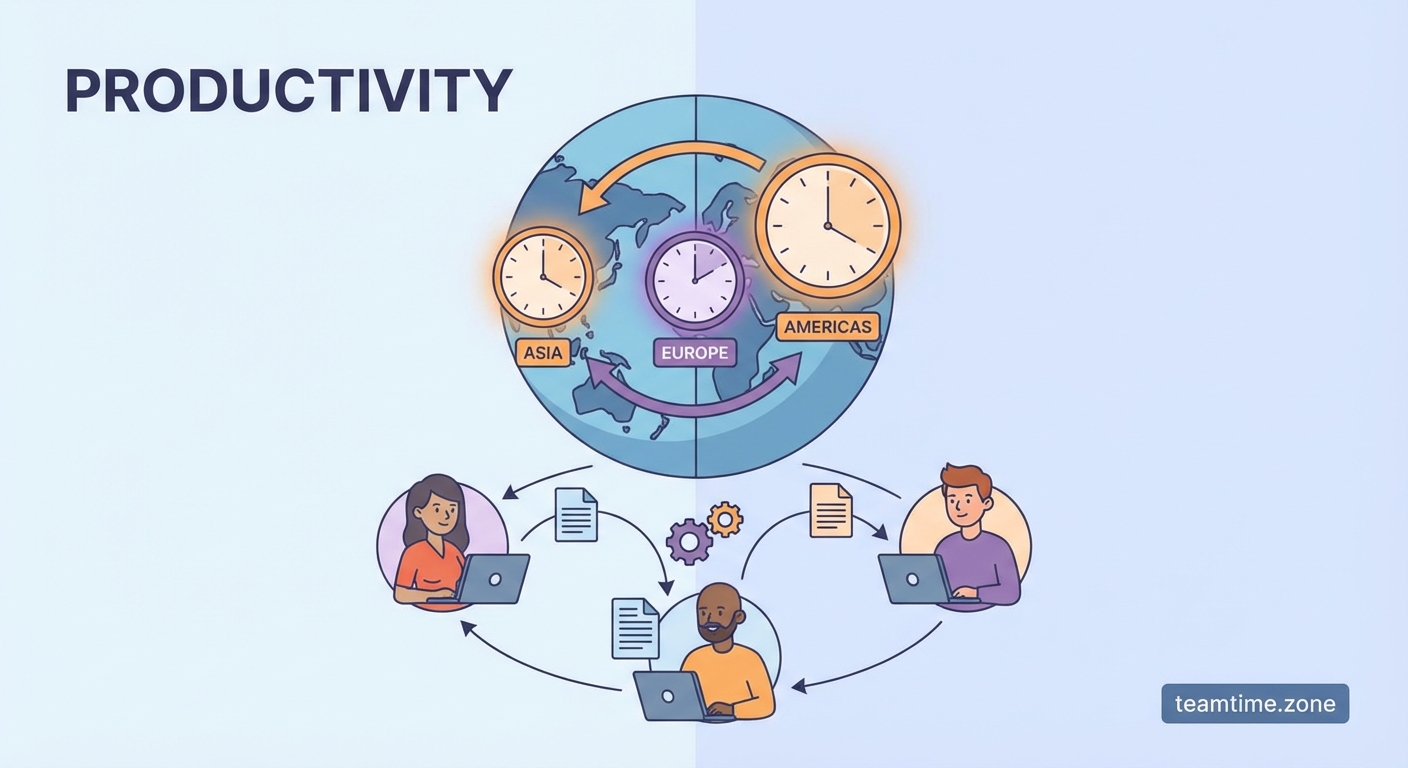
– Americas pod (US, Canada, parts of Latin America)
– EMEA pod (Europe, Middle East, Africa)
– APAC pod (Asia Pacific, Australia)
Some companies split further:
– East Coast US
– West Coast US
– Europe
– India
– Asia Pacific
The right structure depends on where your people are and what coverage gaps you need to fill. Building trust across these distributed pods becomes essential for smooth handoffs.
3. Create detailed handoff documentation templates
This is where most teams fail. They assume people will just figure out what to communicate during handoffs.
They won’t.
You need templates that capture everything the next shift needs to know. Not just what was done, but why decisions were made, what was tried, what didn’t work, and what the next steps should be.
Your template should include:
– Current status summary (2-3 sentences)
– Work completed this shift
– Blockers encountered and how they were addressed
– Decisions made and rationale
– Next actions for the incoming shift
– Links to relevant documentation, tickets, or code
– People to contact if questions arise
Make it easy to fill out. If the template takes 30 minutes to complete, people will skip it. Aim for 5-10 minutes maximum.
4. Establish overlap windows for live handoffs
Even with great documentation, you need some real-time overlap between shifts. This is when the outgoing team can answer questions and the incoming team can clarify priorities.
30-60 minutes of overlap works well. Long enough for meaningful conversation. Short enough that it doesn’t require anyone to work outside normal hours regularly.
During overlap:
– Outgoing shift presents their handoff summary
– Incoming shift asks clarifying questions
– Both teams align on priorities for the next shift
– Any urgent issues get flagged immediately
Record these handoff meetings. Team members who can’t attend live can watch later. Meeting recordings become critical documentation for maintaining context across shifts.
5. Set up tools that support asynchronous handoffs
Your tools either enable smooth handoffs or create friction that kills the workflow.
You need:
– A single source of truth for work status (Jira, Linear, or similar)
– Shared documentation that’s easy to update (Notion, Confluence, or similar)
– Async communication channels organized by project, not by time zone (Slack, Teams)
– Video recording tools for explaining complex issues (Loom, Vimeo)
– Timezone-aware scheduling for the overlap windows you do need
The biggest mistake is using tools designed for co-located teams. Email threads don’t work. Chat channels organized by location create silos. Wikis that require 10 clicks to find information get ignored.
Restructuring your communication channels to support async work makes everything else easier.
6. Measure handoff quality and iterate
Track how well handoffs are working. Don’t just measure output. Measure whether information is flowing smoothly between shifts.
Useful metrics:
– How often does the incoming shift have to wait for clarification?
– How many handoffs result in work continuing immediately vs. pausing?
– What percentage of handoff documentation is complete and useful?
– How long does it take new team members to get up to speed on handoff protocols?
Review these metrics monthly. Ask teams what’s working and what’s frustrating. Adjust your templates, tools, and processes based on real feedback.
Common mistakes that break follow the sun workflows
| Mistake | Why it fails | What to do instead |
|---|---|---|
| Treating all work as equally suited for handoffs | Some tasks require deep context that’s hard to transfer | Identify which workflows benefit from continuous progress and which need single-owner accountability |
| Skipping the overlap windows to save time | Async documentation alone misses nuance and creates misalignment | Protect 30-60 minutes of overlap even if it feels inefficient short-term |
| Using the same handoff template for everything | Different types of work need different information | Create specialized templates for incidents, feature development, support cases, and infrastructure work |
| Organizing teams by function instead of by shift | Creates confusion about who owns what when | Assign clear ownership to each shift pod for specific areas during their working hours |
| Measuring only output speed, not handoff quality | Fast but broken handoffs create rework that slows everything down | Track both delivery speed and how often work has to be redone due to poor handoffs |
Making async communication work for continuous workflows
Follow the sun only works if your team can communicate effectively without everyone being online at the same time.
That means shifting from synchronous defaults to async-first practices.
Instead of jumping on a call to discuss a bug, record a 3-minute video showing the issue, what you’ve tried, and where you’re stuck. The next shift watches it and continues from there.
Instead of waiting for someone to respond in Slack, document your decision in a shared space with your reasoning. If someone disagrees, they can comment with their concerns and alternative approaches.
Instead of scheduling a meeting to align on priorities, use a shared board where each shift updates what they completed and what they’re focusing on next.
Building an async-first communication culture takes time, but it’s non-negotiable for follow the sun workflows. Without it, you end up with constant interruptions as people try to get real-time answers from teammates who are asleep.
Some teams use async standup formats where each shift posts their updates in a shared channel. Others prefer project-based updates where context stays attached to the work itself.
The format matters less than the consistency. Everyone needs to know where to find information and how to contribute updates that help the next shift.
When follow the sun doesn’t make sense
This model isn’t right for every team or every type of work.
It works well for:
– Customer support with global customers
– Incident response and on-call coverage
– Infrastructure operations and monitoring
– Feature development with clear, modular components
– QA and testing workflows
– DevOps and deployment pipelines
It works poorly for:
– Early-stage product development requiring constant collaboration
– Work requiring deep, uninterrupted focus over multiple days
– Projects with high context requirements that are hard to transfer
– Small teams where handoff overhead exceeds the benefits
– Creative work requiring real-time brainstorming and iteration
Before implementing follow the sun, ask whether the work actually benefits from continuous progress or whether it needs sustained attention from the same people.
If your team spends more time doing handoffs than making progress, you’ve chosen the wrong workflow for that type of work. Knowing when async doesn’t work helps you make better decisions about which workflows to optimize for continuous coverage.
Handling the human side of continuous workflows
The logistics of follow the sun are straightforward. The human dynamics are harder.
People worry about losing ownership of their work. They worry about getting blamed when the next shift makes a different decision. They worry about becoming interchangeable.
Address these concerns directly:
Create clear ownership boundaries. Each shift owns their decisions during their working hours. They’re accountable for outcomes, not for following exactly what the previous shift suggested.
Celebrate cross-shift collaboration. When teams successfully hand off complex work, recognize it publicly. Make it clear that good handoffs are a skill worth developing.
Rotate people through different shifts occasionally. This builds empathy and helps everyone understand challenges across time zones. Someone who’s never been on the receiving end of a poor handoff doesn’t understand why documentation matters.
Protect people from timezone bias. Don’t let one location become the “decision-making” shift while others just execute. Preventing timezone bias ensures all shifts have equal authority and opportunity.
Build relationships across shifts. Schedule occasional team events where multiple time zones can participate. Use async celebration methods to recognize wins across all locations.
The goal is making people feel like they’re part of one team that happens to work different hours, not three separate teams competing for resources and recognition.
Scaling follow the sun as your team grows
What works for 15 people across three locations breaks down at 50 people across eight locations.
As you scale, you’ll need:
Specialized pods by function. Instead of general coverage, create follow the sun workflows for specific areas. One for infrastructure. One for API development. One for frontend. Each with its own handoff protocols.
Dedicated handoff coordinators. Someone needs to ensure handoffs are happening smoothly and help resolve issues when they’re not. This role becomes critical above 30-40 people.
More sophisticated tooling. Manual handoff documentation doesn’t scale. You’ll need automation that prompts people for updates, surfaces blockers, and tracks handoff quality.
Formalized training. Onboarding new team members into a follow the sun workflow requires specific training on handoff protocols, documentation standards, and async communication norms.
Better scheduling tools. Coordinating overlap windows across multiple pods and time zones gets complex fast. Timezone-aware scheduling tools become essential rather than nice to have.
Start simple. Prove the model works with one team or one workflow. Then expand gradually based on what you learn.
Protecting focus time in a 24/7 workflow
The biggest risk of follow the sun is creating an always-on culture where people feel obligated to respond outside their working hours.
Just because work is happening 24/7 doesn’t mean individuals should be available 24/7.
Set explicit expectations:
– No one should check messages outside their working hours
– Urgent issues go through defined escalation paths, not personal DMs
– Response time expectations are measured in hours, not minutes
– Each shift is empowered to make decisions without waiting for other time zones
Protecting deep work time becomes even more important when work is continuous. People need blocks of uninterrupted time to make meaningful progress, not just respond to handoffs.
Build in buffer time between handoffs and focused work. If your overlap window ends at 10 AM, don’t schedule deep work immediately after. Give people 30 minutes to process handoff information and organize their priorities before expecting focused output.
Real-world follow the sun workflow examples
Support team example:
- North America shift (8 AM – 5 PM ET): Handles incoming tickets, resolves tier 1 issues, escalates complex problems with detailed notes
- EMEA shift (8 AM – 5 PM GMT): Picks up escalated tickets, continues technical investigations, hands off unresolved issues
- APAC shift (8 AM – 5 PM IST): Completes solutions, verifies fixes, prepares summary for North America shift
Each shift has 1 hour overlap with the next. Handoff includes ticket status, customer context, troubleshooting steps attempted, and recommended next actions.
Engineering team example:
- US West shift: Implements features based on design specs, writes tests, submits PRs with detailed descriptions
- India shift: Reviews PRs, runs extended test suites, fixes bugs found during testing, updates documentation
- Europe shift: Handles deployment, monitors for issues, creates tickets for any problems, starts next feature cycle
Handoffs happen via detailed PR descriptions, recorded code walkthroughs for complex changes, and a shared project board showing current status.
Incident response example:
- Each region has designated on-call coverage during their business hours
- Incidents are handed off with full timeline, impact assessment, mitigation steps taken, and current status
- Post-incident reviews happen async with contributions from all shifts involved
- Runbooks are updated immediately after each incident by the shift that resolved it
The key in all cases is making information transfer seamless and empowering each shift to make decisions rather than just following instructions.
Measuring success beyond delivery speed
Yes, follow the sun workflows should reduce time to delivery. But that’s not the only metric that matters.
Track:
- Employee satisfaction across time zones. Are people in all locations equally happy with the workflow? Or is one shift bearing most of the burden?
- Handoff completion rates. What percentage of handoffs include all required information?
- Rework frequency. How often does work need to be redone because of miscommunication between shifts?
- Knowledge distribution. Is expertise concentrated in one location or spread across shifts?
- Onboarding time. How long does it take new hires to become productive in the follow the sun model?
The best implementations improve both speed and quality of work while maintaining healthy work-life balance across all time zones.
If your metrics show faster delivery but declining employee satisfaction or increasing rework, something in your handoff process needs fixing.
Making follow the sun work for your team
Building a follow the sun workflow isn’t about copying what other companies do. It’s about understanding your team’s specific needs and designing handoffs that work for your context.
Start small. Pick one workflow that would clearly benefit from continuous progress. Implement basic handoff protocols. Measure what happens. Adjust based on feedback.
The teams that succeed with this model are the ones that treat handoffs as a core skill worth investing in, not an administrative burden to minimize. They document thoroughly. They protect overlap time. They empower each shift to make decisions.
Most importantly, they recognize that follow the sun is fundamentally about respecting people’s time across all locations. When you get that right, the productivity gains follow naturally.