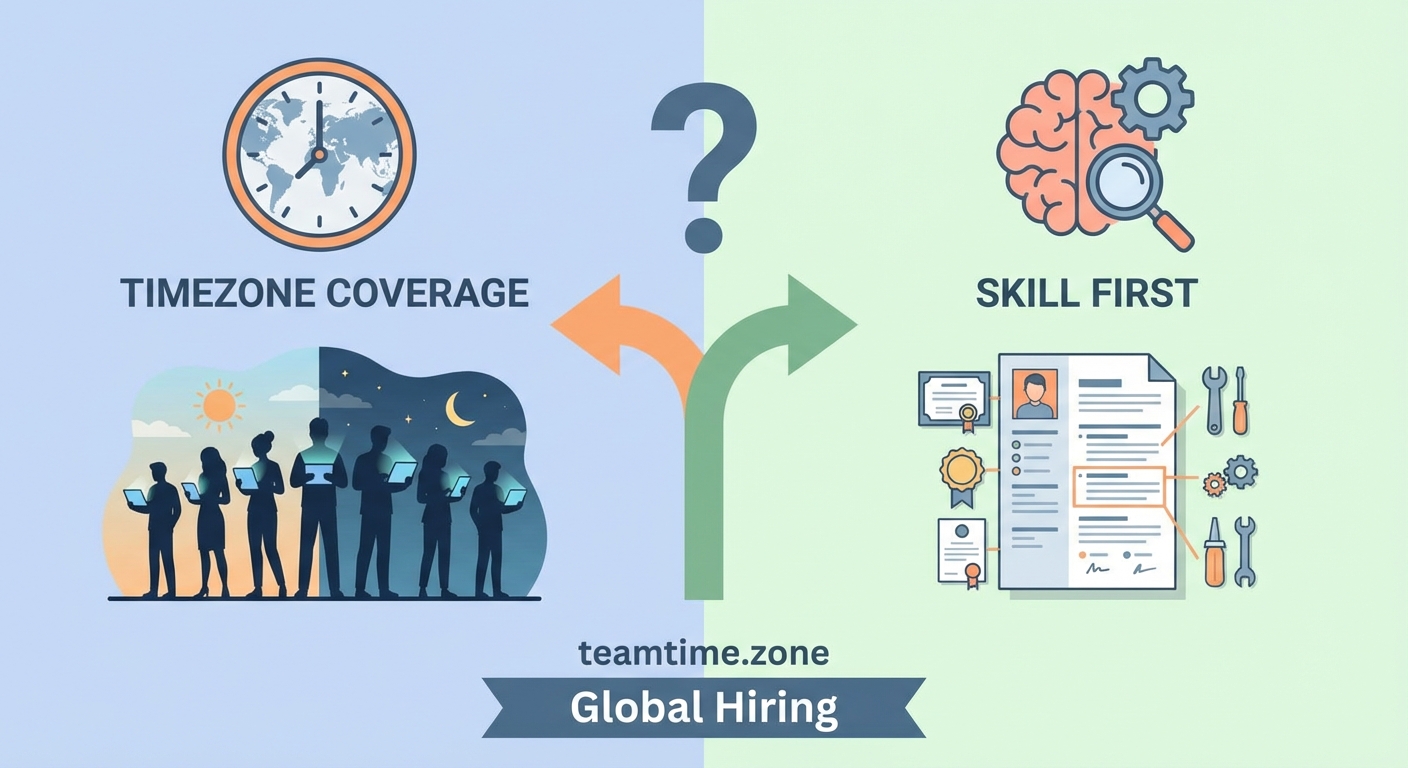
You’re staring at two candidates. One has the exact skills you need but works during your team’s off-hours. The other offers perfect timezone overlap but lacks some technical depth. Which one do you choose?
This tension sits at the heart of building distributed teams. Hiring for timezone coverage sounds strategic until you realize it might mean passing on exceptional talent. But ignoring geography entirely can leave your team struggling with delayed responses and fractured collaboration.
Successful distributed hiring starts with defining your coverage needs before posting jobs. Most teams need 4-6 hours of overlap, not 24/7 availability. Prioritize skills first, then use async workflows and strategic scheduling to bridge timezone gaps. Geography becomes a filter, not a requirement. The best candidates adapt to your communication culture, regardless of their clock.
Understanding what timezone coverage actually means
Timezone coverage doesn’t mean someone is always online. It means your team can maintain momentum without constant handoffs or waiting.
Think about what you actually need. Customer support teams might require continuous coverage across business hours in multiple regions. Engineering teams often need concentrated collaboration time, not round-the-clock availability.
Many managers confuse coverage with overlap. Coverage means having team members distributed across timezones. Overlap means having hours when everyone can meet synchronously.
You need both, but in different proportions depending on your work.
A design team might thrive with 4 hours of daily overlap for feedback sessions, then work independently the rest of the day. A support team needs staggered shifts to answer tickets as they arrive.
Define your minimum viable overlap before you write job descriptions. Most teams discover they need less than they think.
The real cost of prioritizing geography over skills

Hiring someone primarily for their timezone creates downstream problems that compound over months.
You’ll spend more time training someone who lacks core competencies. Your senior team members will carry extra weight. Projects take longer because the person in the “right” timezone can’t execute without heavy guidance.
I’ve seen startups hire three mediocre developers across different continents when two excellent developers in overlapping zones would have shipped faster.
The math seems simple: more timezones equals more coverage. But skill gaps don’t disappear just because someone answers Slack messages at convenient times.
“We hired for timezone fit and spent six months realizing we’d traded competence for convenience. The person was online when we needed them, but couldn’t solve the problems we hired them to handle.” – Engineering Manager at a Series B SaaS company
Geographic diversity matters for perspective and market understanding. But it shouldn’t override capability.
When timezone coverage should drive your hiring decisions
Some roles genuinely require specific geographic distribution.
Customer-facing positions often need timezone coverage by design. If you serve customers in Asia-Pacific, having team members awake during those business hours prevents frustrating 12-hour response delays.
Support teams benefit from strategic timezone distribution. Hiring someone in Manila to cover APAC hours makes sense when ticket volume justifies it.
Sales teams need coverage that matches prospect availability. Calling Australian businesses from California means early mornings or late nights for someone.
Operations roles that handle time-sensitive processes, like payment processing or system monitoring, may need geographic spread to prevent single points of failure.
Here’s when geography should be a primary filter:
- You have documented demand during specific hours that your current team can’t sustainably cover
- The role requires real-time interaction with customers or partners in that timezone
- Regulatory or compliance requirements mandate local presence
- You’re building redundancy for critical systems that can’t wait for handoffs
Notice what’s missing from that list: “because it would be nice” or “for better coverage.”
Building a hiring framework that balances both factors
Start with a simple prioritization matrix before you post any job.
-
List the core competencies the role requires. Be specific. “Strong communicator” is vague. “Can write technical documentation that non-technical stakeholders understand” is measurable.
-
Define your timezone requirements. Not preferences. Requirements. What’s the minimum overlap needed? What hours must someone be available for? What can happen asynchronously?
-
Assign weights to each factor. If the role is 80% independent work and 20% collaboration, timezone overlap shouldn’t be weighted equally with technical skills.
Create a scoring rubric that reflects these weights. A senior engineering role might score candidates like this:
| Criteria | Weight | Candidate A (UTC+8) | Candidate B (UTC-5) |
|---|---|---|---|
| Technical depth | 40% | 9/10 | 6/10 |
| Communication clarity | 25% | 8/10 | 8/10 |
| Timezone overlap | 20% | 4/10 | 9/10 |
| Cultural fit | 15% | 8/10 | 7/10 |
| Total Score | 7.35 | 7.30 |
This framework prevents gut decisions. You can see exactly where tradeoffs exist.
Candidate A wins despite less overlap because technical depth carries more weight. But it’s close enough that you’d want to verify your async workflows can support that timezone gap.
If Candidate B had scored 9/10 on technical depth, they’d win clearly. The framework adapts to the actual candidate pool.
Strategies for making geography work in your favor
You can hire for skill and still build timezone coverage through intentional team design.
Cluster hiring in strategic regions. Instead of one person in each timezone, hire 2-3 people in regions that give you the coverage you need. This creates local support networks and reduces isolation.
A team spanning San Francisco, London, and Singapore covers 24 hours with just three hubs. Each location can have multiple team members who collaborate locally.
Use timezone gaps for focused work. Deep work across time zones becomes easier when you’re not constantly interrupted. Your Berlin-based developer gets morning focus time before San Francisco wakes up.
Design workflows that treat timezones as a feature, not a bug. Follow-the-sun workflows let teams hand off work at the end of their day, so progress continues around the clock.
Build async-first communication into your culture from day one. This removes the pressure to have perfect timezone overlap because most communication doesn’t require real-time responses.
Implement clear response time expectations so people know what’s urgent and what can wait. This prevents timezone differences from creating artificial urgency.
Common mistakes that sabotage distributed hiring
The biggest mistake is hiring for timezone first, then trying to train up skills later. It rarely works.
You end up with a team that’s geographically distributed but functionally weak. Projects stall because the person in the “right” timezone can’t execute without hand-holding.
Another trap: assuming more overlap always equals better collaboration. Some teams force everyone into uncomfortable hours to maximize synchronous time, then wonder why productivity drops.
A developer in Sydney shouldn’t regularly take 9pm calls to accommodate New York’s morning. That’s not sustainable.
Ignoring timezone bias in your processes creates invisible barriers. If all your important meetings happen during US hours, your APAC team members become second-class contributors. Preventing timezone bias requires intentional process design.
Failing to document decisions asynchronously means people in different timezones miss context. They show up to work without understanding what changed overnight. Documenting decisions properly prevents this fragmentation.
Treating timezone coverage as a checkbox instead of a system creates gaps. You hire someone in Singapore for APAC coverage, but don’t adjust your meeting schedules, communication patterns, or workflows. Then you’re frustrated when it doesn’t work.
How to evaluate candidates across timezone boundaries
Remote interviews introduce their own challenges when candidates span the globe.
Schedule initial screenings at times that work for both parties, even if it’s slightly inconvenient. If you’re unwilling to take one early morning call to interview someone, you’re probably not ready to manage them across timezones.
Test async communication skills during the interview process. Send candidates a written scenario and ask them to respond in writing. See how they structure information when they can’t rely on real-time clarification.
Strong distributed team members over-communicate context. They anticipate questions. They document their thinking. These skills matter more than timezone.
Use timezone-aware scheduling tools to prevent embarrassing mistakes like booking interviews at 3am candidate time.
Ask candidates how they’ve handled timezone challenges before. Specific examples reveal more than hypothetical answers.
- How did you stay connected to a team in a different timezone?
- Describe a time you had to make a decision without real-time input from your manager.
- How do you structure your communication when you can’t tap someone on the shoulder?
Pay attention to how candidates communicate throughout your hiring process. Do they send clear, complete messages? Or do they rely on back-and-forth to get basic information across?
The interview process itself becomes a working sample of how they’ll operate on your team.
Designing roles that work across any timezone
Some roles are naturally timezone-flexible. Others require modification to work in a distributed context.
Break down the role into tasks that need synchronous collaboration versus independent execution. Most roles are 70-80% independent work if you structure them properly.
A content writer might need 2 hours per week of synchronous feedback sessions but can execute all writing, research, and editing asynchronously. That role works in any timezone with minimal overlap.
A project manager coordinating multiple stakeholders needs more synchronous time but can still operate with 4-6 hours of overlap if they use async standups and clear documentation.
Rewrite job descriptions to reflect actual timezone requirements, not assumptions.
Instead of: “Must be available during US business hours”
Write: “Role requires 4 hours of overlap with US Eastern timezone (9am-1pm ET) for team collaboration. Remaining hours are flexible.”
This attracts candidates who can meet your real needs without excluding everyone outside North America.
Build flexibility into role design. Can this person set their own core hours within a range? Can they shift their schedule seasonally? Can they work 4 longer days instead of 5 shorter ones to maximize overlap?
The more flexibility you build in, the larger your talent pool becomes.
Making your final decision with confidence
You’ve interviewed candidates. You’ve scored them against your framework. Now you need to decide.
Look at your scores, but also consider team composition. If your entire engineering team is in Europe, adding someone in Asia might create more isolation than value. Sometimes the second-best candidate on paper becomes the best choice for team dynamics.
Consider growth trajectory. A candidate with 85% of the skills you need today but strong learning ability might outperform someone at 100% who’s plateaued.
Timezone challenges are solvable through process. Skill gaps are harder to close.
Ask yourself: “Can we support this person’s success given their timezone?” If you don’t have async workflows in place, hiring someone with minimal overlap sets them up to fail.
But if you have solid async practices, documentation culture, and meeting recordings, timezone becomes much less important.
Run a mental simulation. Imagine this person starting next month. What breaks? What needs adjustment? If the answer is “everything,” you might not be ready for that timezone gap yet.
If the answer is “we need to record our standups and be more thoughtful about meeting times,” that’s manageable.
Setting new hires up for success across timezones
Your work doesn’t end when you extend an offer. Onboarding across timezones requires extra intentionality.
Create a timezone-aware onboarding checklist that doesn’t assume someone can attend every training session live.
Record everything. Onboarding videos, tool walkthroughs, team introductions, and process explanations should all exist in recorded formats.
Assign a buddy in a similar timezone if possible. If not, assign someone who has experience working asynchronously and won’t expect immediate responses.
Set explicit expectations about communication patterns in the first week. When should they expect responses? What’s urgent versus what can wait? How should they ask questions?
Schedule dedicated onboarding time during overlap hours. Don’t waste precious synchronous time on information that could be delivered asynchronously.
Use overlap for relationship building, questions, and interactive training. Use async time for documentation review, system setup, and independent learning.
Check in frequently during the first month. Timezone isolation can make new hires feel disconnected. Regular 1-on-1s during their working hours signal that you’re invested in their success.
Measuring whether your timezone strategy works
You need metrics to know if your approach is actually working.
Track response times across timezones. Are certain team members consistently waiting longer for answers? That indicates a coverage gap or communication problem.
Monitor meeting attendance patterns. If people in certain timezones regularly miss important meetings, your scheduling is broken.
Survey team satisfaction. Ask specifically about timezone challenges. “Do you feel included in team decisions despite timezone differences?” reveals problems that metrics might miss.
Measure project velocity. Are projects with distributed teams moving slower than co-located ones? Some slowdown is normal, but significant delays suggest your processes need work.
Look at retention across timezones. If people in certain regions leave more frequently, you might have timezone bias in your culture.
Review your hiring data every quarter. What percentage of your best hires came from outside your primary timezone? This tells you whether you’re successfully balancing geography and skill.
If all your top performers are in one timezone cluster, you might be over-indexing on overlap at the expense of talent.
Building a team that works from anywhere
The goal isn’t perfect timezone coverage. It’s building a team that ships great work regardless of where people are located.
Skills matter most. Geography matters, but less than you think. The right processes make timezone differences nearly invisible.
Start with a clear framework. Know what you need before you hire. Weight your criteria honestly. Don’t let “good timezone fit” override “can actually do the job.”
Build systems that support distributed work. Async communication, clear documentation, and thoughtful meeting design matter more than having everyone online simultaneously.
Hire the best people you can find. Then build the processes that help them succeed, wherever their desk happens to be.
Your next great hire might be 12 timezones away. Don’t let geography stop you from finding them.