
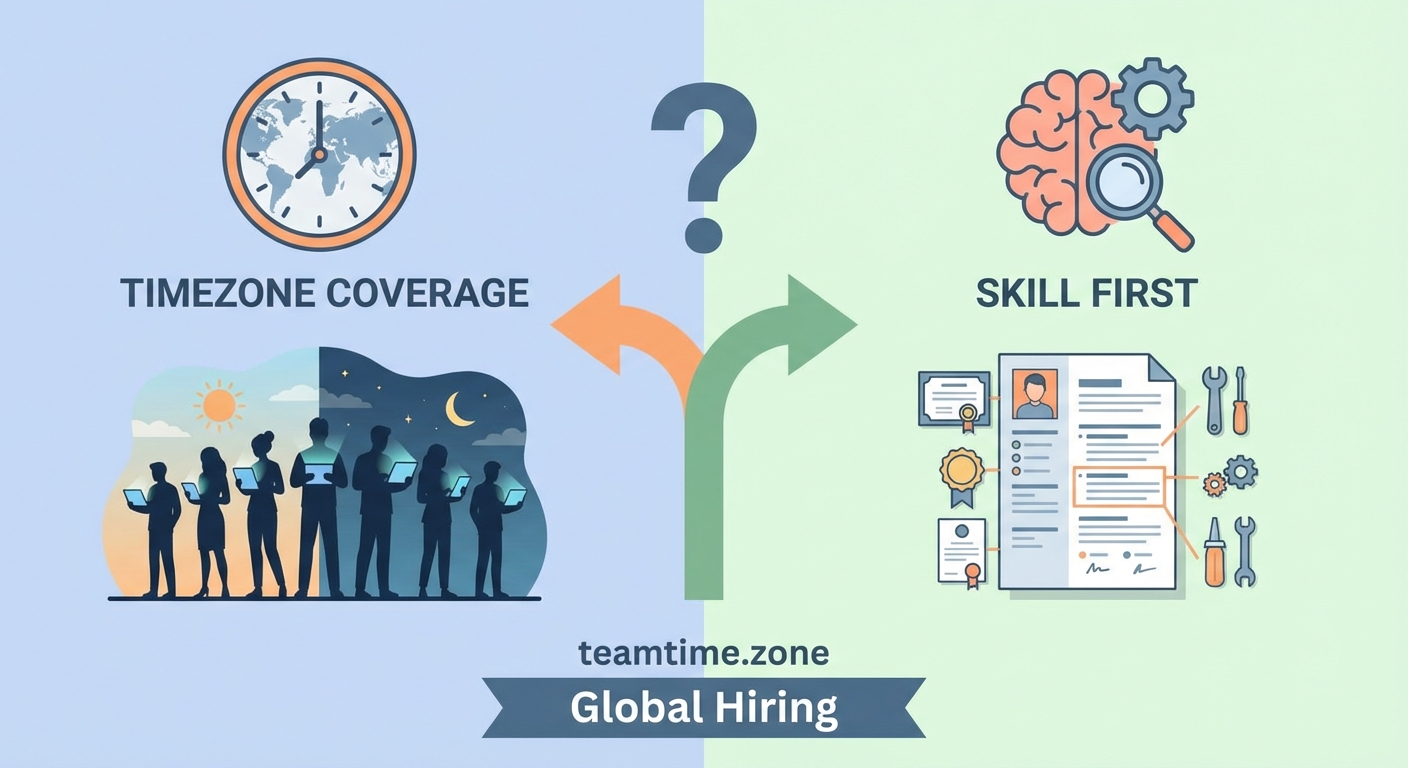
You’re staring at two final candidates. One lives in the perfect timezone for 24/7 coverage but lacks a key technical skill. The other is brilliant but works while your entire team sleeps. Which do you choose?
This isn’t a hypothetical problem. It’s the hiring dilemma that keeps remote team leaders up at night. And the answer isn’t as simple as “always hire the best person” or “coverage comes first.”
Hiring for timezone coverage versus skill depends on your team’s workflow structure. Synchronous teams need overlap. Asynchronous teams prioritize expertise. Most companies need both, which means defining must-have collaboration windows, building async systems first, then hiring the best talent who can meet your minimum overlap requirements. Geography becomes a filter, not the deciding factor.
Why This Question Even Exists
Ten years ago, this wasn’t a debate.
You hired locally or you hired from a handful of established outsourcing hubs. Timezone coverage meant paying for night shifts or accepting delayed responses.
Remote work changed everything. Suddenly you could hire a senior developer in Buenos Aires, a designer in Manila, and a product manager in Warsaw. The talent pool exploded. But so did the coordination complexity.
Now you’re choosing between a candidate who can join your daily standup and one who will miss every single real-time meeting. The decision feels impossible because both options have real costs.
What Timezone Coverage Actually Means

Let’s get specific about what we’re discussing.
Timezone coverage refers to how many hours your team can actively collaborate in real time. It’s not just about someone being awake. It’s about shared working hours where people can talk, make decisions, and solve problems together.
A team with good coverage has at least 3-4 hours of overlap across all members. A team with poor coverage might have zero hours where everyone is online simultaneously.
Here’s what different coverage levels look like:
| Coverage Level | Overlap Hours | What You Can Do | What Breaks |
|---|---|---|---|
| Full overlap | 6+ hours | Real-time collaboration, spontaneous calls, instant decisions | Limited talent pool, expensive hires |
| Good overlap | 3-5 hours | Scheduled meetings, daily standups, urgent problem solving | Some async required, recording needed |
| Minimal overlap | 1-2 hours | Brief check-ins, critical updates only | Most work happens async, slower decisions |
| No overlap | 0 hours | Everything asynchronous | Real-time collaboration impossible |
Most distributed teams fall into the “good overlap” or “minimal overlap” categories. That’s where the hiring tension lives.
When Timezone Coverage Should Win
Some roles genuinely need geographic alignment. Not because of tradition or preference, but because the work structure demands it.
Customer support is the obvious example. If you serve U.S. customers and have no one online during U.S. business hours, you’re not providing support. You’re providing delayed email responses.
Sales teams often need timezone alignment too. Calling prospects at 2 AM their time doesn’t work. Neither does asking your sales rep to work graveyard shifts permanently.
Here are roles where timezone coverage typically matters more than marginal skill differences:
- Customer-facing positions with specific coverage requirements
- Roles that require frequent real-time collaboration with a specific team
- Positions involving live events, launches, or time-sensitive operations
- Jobs where training and onboarding happen primarily through synchronous sessions
Notice the pattern. These are roles where the work itself is synchronous by nature. Building trust in remote teams matters, but some jobs require real-time presence regardless of trust levels.
If your role requires responding to live situations or coordinating with external stakeholders in a specific timezone, geography isn’t a nice-to-have. It’s a job requirement. Treat it like any other must-have skill.
When Skill Should Win Every Time
Now flip the scenario.
You’re hiring a senior backend engineer. The role involves complex architectural decisions, code reviews, and building systems that will serve your product for years.
You have two candidates. One is competent and lives in your timezone. The other is exceptional, has solved the exact problems you’re facing, and lives 8 hours away.
Choosing the local candidate because of timezone convenience is a mistake. Here’s why.
Engineering work, especially at senior levels, is largely asynchronous. Code doesn’t care what time it was written. Documentation works at any hour. Pull requests can be reviewed on different schedules.
The cost of hiring a mediocre engineer compounds. You get slower development, more bugs, technical debt, and eventually the need to hire someone else to fix the problems. The timezone convenience doesn’t offset these costs.
Roles where skill should dominate your hiring decision:
-
Technical positions with deep expertise requirements. Senior engineers, data scientists, security specialists. The skill gap between good and great is massive.
-
Creative roles where quality matters more than speed. Writers, designers, video producers. A brilliant designer working async produces better results than an average one available for meetings.
-
Strategic positions that require rare experience. Product leaders who’ve scaled similar products, growth experts with proven track records. These people are hard to find. Don’t eliminate them over timezone.
The key question is this: can the work be done asynchronously without significant quality loss? If yes, optimize for skill.
The Async-First Advantage
Here’s the uncomfortable truth most companies avoid.
If you can’t function with team members in different timezones, your processes are broken. Timezone coverage is masking deeper organizational problems.
Healthy distributed teams build async-first communication cultures from day one. They document decisions, write clear updates, and default to asynchronous workflows.
This doesn’t mean never meeting. It means meetings are optional, not required. Information flows through documentation, not verbal conversations. Decisions happen in writing, not in Zoom calls.
When you build async systems first, timezone becomes less important. You can hire the best person regardless of location because your team doesn’t depend on everyone being online simultaneously.
Companies that do this well:
- Write everything down in accessible places
- Record meetings and share summaries
- Use async standups instead of daily calls
- Make decisions in documents with clear approval processes
- Set realistic response time expectations instead of demanding instant replies
The benefit goes beyond hiring. Async-first teams are more inclusive, more documented, and more resilient. When someone goes on vacation or changes timezones, the team keeps functioning.
Building Your Hiring Framework
Stop treating this as an either/or decision. Build a framework that accounts for both factors.
Here’s a practical process:
-
Define your minimum viable overlap. What’s the least amount of shared working hours this role needs? Be honest. Many roles that “require” 6 hours of overlap actually need 2.
-
Identify your collaboration critical points. When does this person absolutely need to be available? Weekly planning? Client calls? Emergency responses? List them specifically.
-
Assess your async infrastructure. Do you have the systems to support someone working different hours? If not, can you build them? Async workflow templates can help here.
-
Weight the skill gap honestly. How much better is the out-of-timezone candidate? If it’s marginal, timezone might be the tiebreaker. If it’s significant, timezone shouldn’t eliminate them.
-
Calculate the real costs. What does poor timezone coverage cost you? What does hiring a less skilled person cost you? Put numbers on both.
This framework prevents lazy thinking. “We need someone in our timezone” becomes “we need 3 hours of overlap for weekly planning and client emergencies.” That’s a much easier problem to solve.
Common Mistakes That Make This Harder
Most timezone hiring problems are self-inflicted. Companies create unnecessary constraints, then wonder why hiring is difficult.
Mistake 1: Requiring full-time overlap for async work.
You don’t need your content writer online during your meetings. You need them to produce great content. The overlap requirement is artificial.
Mistake 2: Using synchronous processes for everything.
If every decision requires a meeting, you’ve built a synchronous company. That’s a choice, not a requirement. Documenting decisions asynchronously is learnable.
Mistake 3: Optimizing for convenience over outcomes.
Hiring someone in your timezone is convenient. It makes scheduling easy. But convenience isn’t the goal. Results are.
Mistake 4: Ignoring timezone bias.
Teams unconsciously favor people in their timezone for promotions, projects, and opportunities. This creates a two-tier system where remote workers in different timezones get left behind. Preventing timezone bias requires active effort.
Mistake 5: Not testing async workflows before hiring globally.
Don’t hire your first distributed team member and hope it works out. Build the async systems first. Test them with your current team. Then expand geographically.
What Great Distributed Hiring Looks Like
Companies that solve this well follow patterns.
They start by auditing their actual collaboration needs. Not what they think they need, but what the work actually requires. They track meetings, decision-making processes, and communication patterns.
Then they categorize roles:
- Timezone-dependent roles: Must have specific geographic coverage
- Timezone-flexible roles: Need some overlap but can work async
- Timezone-independent roles: Can work from anywhere with minimal constraints
For timezone-flexible roles, they define the minimum overlap requirement. Maybe it’s 2 hours with the core team. Maybe it’s 4 hours with one specific person. The requirement is clear and justified.
They build async infrastructure before hiring globally. Documentation systems, decision-making processes, meeting recording practices. The team proves they can work asynchronously before adding timezone complexity.
When they hire, skill is the primary filter. Timezone is a secondary constraint applied only where genuinely necessary.
This approach expands the talent pool dramatically while maintaining team effectiveness. You’re not choosing between coverage and skill. You’re hiring skilled people who meet your actual coverage needs.
Special Cases Worth Considering
Some situations break the standard framework.
Hiring your first remote employee: If your entire team is co-located and you’re hiring your first remote person, timezone coverage might matter more initially. You haven’t built async systems yet. Starting with someone in a similar timezone gives you time to adapt. But don’t let this become permanent. Build async capabilities quickly.
Building follow-the-sun teams: Some companies intentionally hire across timezones for continuous coverage. Customer support, DevOps, and monitoring roles benefit from this. Here, timezone is part of the strategy, not a constraint. You’re specifically hiring for follow-the-sun workflows.
Scaling rapidly: When you’re hiring 10 people in 3 months, coordination complexity matters more. You might prioritize timezone coverage temporarily to avoid overwhelming your systems. But this should be a short-term tactical decision, not a permanent policy.
Highly regulated industries: Some sectors have legal or compliance requirements around working hours, data access, or geographic location. These are real constraints. Don’t confuse them with preference.
Tools That Make Timezone Differences Manageable
The right tools reduce timezone friction significantly.
Meeting scheduling tools that respect timezones prevent the embarrassing “I scheduled our call at 3 AM your time” mistakes. They make coordination easier but don’t solve the underlying workflow problem.
Calendar tools that show multiple timezones help teams visualize overlap. But again, they’re Band-Aids if your processes require constant synchronous collaboration.
Meeting recordings done right make timezone differences less painful. People who can’t attend live can catch up asynchronously. This only works if you actually record, summarize, and share meetings consistently.
Async communication platforms matter more than timezone converters. Tools that support threaded discussions, clear documentation, and searchable history enable distributed work. Slack, Notion, Linear, and similar platforms become your shared workspace.
The tool stack matters. But it’s secondary to workflow design. Fix your processes first, then find tools that support them.
Making the Decision for Your Next Hire
You still have two candidates. One with great timezone coverage, one with exceptional skills but poor overlap.
Here’s how to decide:
Ask yourself: if we hire the timezone-convenient candidate, what’s the cost of their skill gap over the next year? Will we need to hire someone else to compensate? Will projects take longer? Will quality suffer?
Then ask: if we hire the skilled candidate in a different timezone, what do we need to change to make it work? Can we shift some meeting times? Can we move more work async? Can we record and summarize key discussions?
If the timezone-convenient candidate is 80% as good and the changes needed for the remote candidate are minimal, hire remote and make the changes. Your team will be stronger for it.
If the timezone-convenient candidate is 95% as good and accommodating the remote candidate requires rebuilding your entire workflow, the local hire might make sense. But recognize you’re choosing convenience over a small skill advantage.
If the timezone-convenient candidate is 60% as good, hire the remote candidate and fix your processes. The skill gap is too large to ignore.
What This Means for Your Hiring Strategy
The hiring for timezone coverage versus skill debate reveals something bigger.
It exposes whether your company is truly remote-first or just remote-allowed. Remote-first companies build systems that work across timezones. Remote-allowed companies try to maintain office-style synchronous work with distributed people.
The companies winning the talent war are remote-first. They’ve accepted that timezone distribution is a feature, not a bug. It gives them access to global talent, forces better documentation, and creates more inclusive cultures.
Your hiring strategy should reflect this reality. Define the actual overlap needed for each role. Build async systems that reduce synchronous dependency. Then hire the best people who meet your minimum requirements, regardless of where they live.
This isn’t about choosing between coverage and skill. It’s about building a company that doesn’t have to choose.
Start by auditing one team. Track how much of their work genuinely requires real-time collaboration. You’ll probably find it’s less than you think. That’s your opportunity to hire better people from anywhere.
Leave a Reply