Working with a team spread across Tokyo, Berlin, and San Francisco sounds exciting until you realize your calendar looks like a game of Tetris designed by someone who hates you. Every time you carve out two hours for focused work, a meeting request from another continent appears.
The promise of global collaboration comes with a hidden cost: your ability to think deeply gets chopped into fragments too small to accomplish anything meaningful.
Deep work across time zones requires deliberate boundaries and async-first communication. Protect your focus hours by mapping team overlaps, establishing response time norms, and designing workflows that don’t depend on instant replies. The goal isn’t to be available 24/7 but to create predictable windows where collaboration happens without destroying individual productivity.
Why Time Zones Destroy Deep Work
Cal Newport defines deep work as focused, uninterrupted time spent on cognitively demanding tasks. It’s how you write the proposal that wins the contract, debug the persistent system error, or design the feature that sets your product apart.
Time zones make this nearly impossible without intentional design.
When your team spans multiple continents, someone is always starting their day while you’re ending yours. The natural response is to stay connected longer, check messages more frequently, and schedule meetings at odd hours to accommodate everyone.
This creates a culture of constant availability.
Your brain never gets the uninterrupted blocks it needs to produce meaningful work. Research shows it takes an average of 23 minutes to regain focus after an interruption. If you’re checking Slack every 15 minutes to stay responsive to global colleagues, you never reach the mental state where complex problem-solving happens.
The solution isn’t working longer hours. It’s redesigning how your team communicates and collaborates.
Understanding Your Team’s Overlap Reality
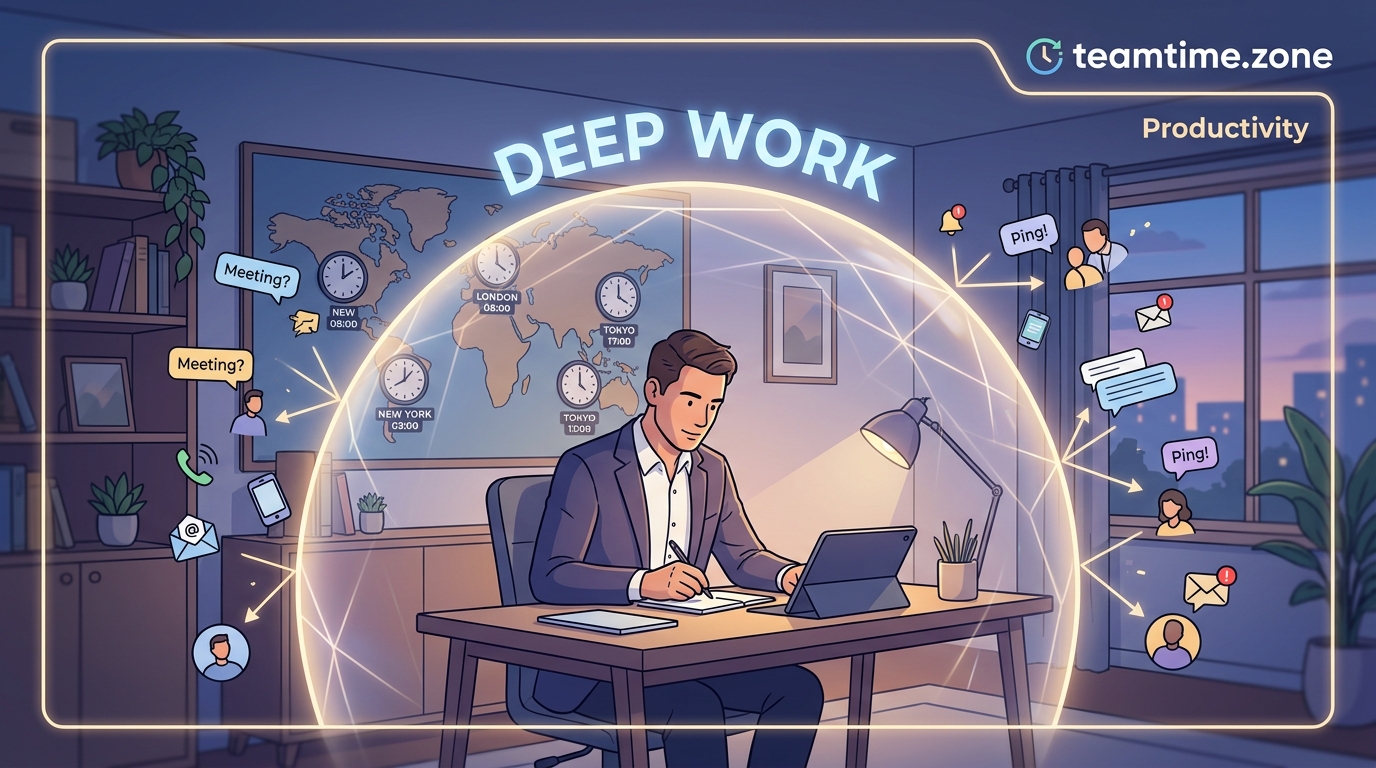
Before you can protect deep work time, you need to see your team’s time zone situation clearly.
Start by mapping when everyone actually works. Not their official hours, but when they’re genuinely available and productive. A developer in Manila might officially work 9 to 5, but if they have family commitments until 10 AM, that changes your overlap calculation.
Create a simple table showing each team member’s working hours in a common reference time zone:
| Team Member | Location | Working Hours (UTC) | Overlap with Core Team |
|---|---|---|---|
| Sarah | New York | 13:00 – 21:00 | 4 hours |
| Marcus | London | 08:00 – 16:00 | 3 hours |
| Yuki | Tokyo | 00:00 – 08:00 | 0 hours |
| Ana | São Paulo | 11:00 – 19:00 | 2 hours |
This table reveals the uncomfortable truth: you might have zero hours when everyone is available simultaneously.
That’s actually fine. You don’t need everyone online at once. You need enough overlap for essential collaboration, and you need to protect the non-overlap time for deep work.
Most distributed teams discover they have 2 to 4 hours of genuine overlap. That’s your collaboration window. Everything else should be asynchronous.
The Three-Zone Framework for Protecting Focus
Divide your workday into three distinct zones: collaboration time, deep work time, and flex time.
Collaboration time is your overlap window with the team. This is when you attend meetings, have real-time discussions, and make decisions that benefit from immediate back-and-forth. Block this time on your calendar and make yourself genuinely available.
Deep work time is your protected focus period. No meetings, no Slack, no email. This is when you tackle the cognitively demanding work that actually moves projects forward. Schedule this during your personal peak productivity hours, which might fall outside your team’s overlap window.
Flex time handles everything else: responding to messages, reviewing documents, updating project boards, and handling administrative tasks. This time is interruptible by design.
The key is making these zones visible to your team. If everyone knows you’re in deep work mode from 6 AM to 10 AM Pacific time, they’ll stop expecting immediate responses during those hours.
Building an async-first communication culture makes this framework actually work instead of just looking good on paper.
Setting Response Time Expectations That Protect Focus
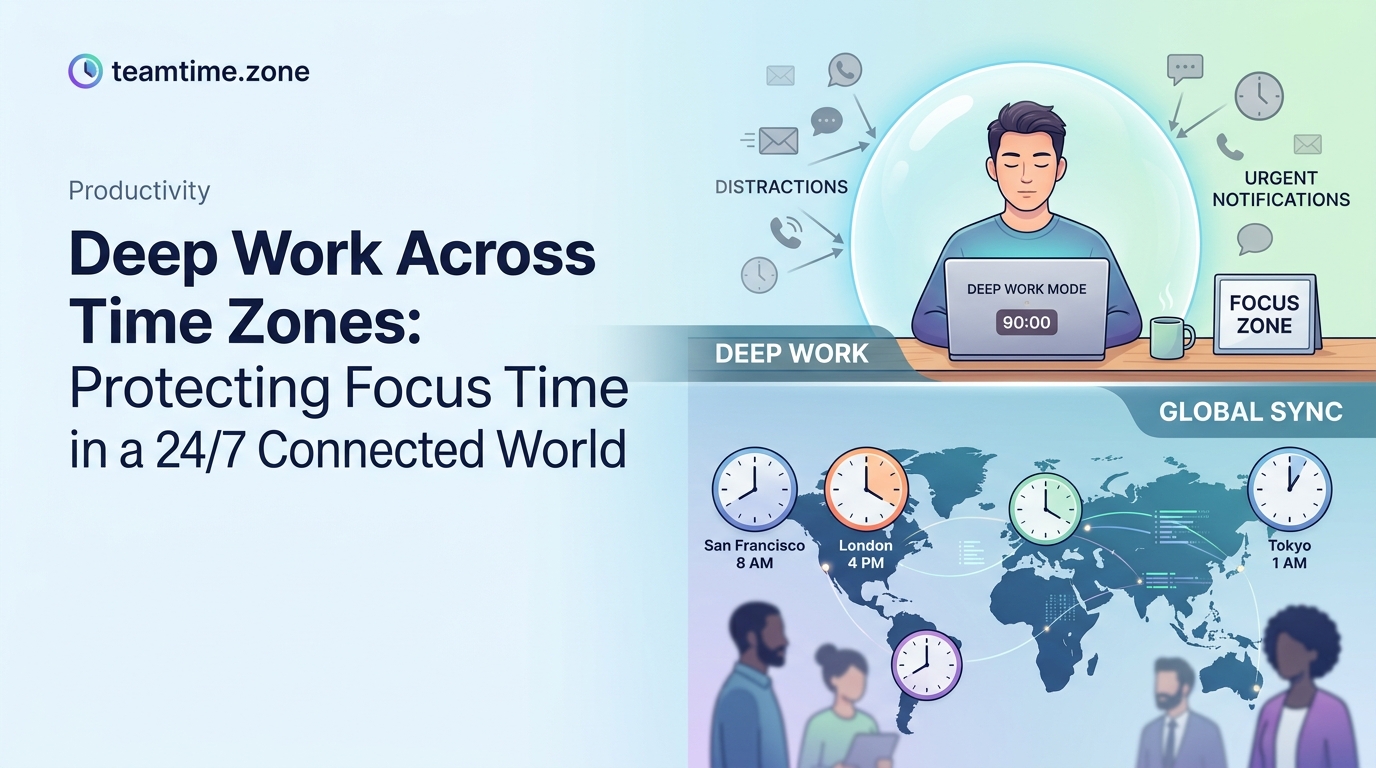
The biggest threat to deep work across time zones isn’t the time difference itself. It’s the expectation of instant responses.
When someone sends you a message at 3 PM their time (which is 6 AM yours), do they expect a reply immediately? In an hour? By end of their workday?
Most teams never explicitly discuss this, so everyone defaults to “as fast as possible.” That kills deep work.
Define clear response time expectations:
- Urgent issues (production down, client emergency): 1 hour during working hours
- Time-sensitive questions (blocking someone’s work): 4 hours during working hours
- Standard communication: 24 hours
- Low-priority updates: 48 hours
Make these expectations explicit in your team documentation. When someone marks a message as urgent, they’re asking you to interrupt your deep work. That should happen rarely.
For everything else, you can batch your responses during flex time without guilt.
“The ability to perform deep work is becoming increasingly rare at exactly the same time it is becoming increasingly valuable in our economy. The few who cultivate this skill will thrive.” This principle applies even more strongly to distributed teams, where the temptation to stay constantly connected is stronger.
Building Async Workflows That Don’t Need You Online
Most “urgent” requests aren’t actually urgent. They feel urgent because your workflow assumes everyone is available simultaneously.
Redesign your processes to work asynchronously.
Instead of scheduling a meeting to make a decision, document the context, options, and your recommendation in a shared document. Give team members 24 hours to add comments. Make the decision based on written feedback.
How to document decisions asynchronously without creating endless message threads transforms how fast your team can move without requiring everyone online together.
Instead of real-time standup meetings, use async updates. Each team member posts what they completed, what they’re working on, and where they’re blocked. The complete guide to async standups shows how to make this actually useful instead of just another obligation.
Instead of jumping on a call to explain something complex, record a 5-minute video walking through the issue. Your teammate in another time zone can watch it during their work hours and respond thoughtfully.
The pattern is simple: replace synchronous communication with rich, asynchronous artifacts that provide full context.
Designing Your Personal Deep Work Schedule
Now that your team operates asynchronously, you can design a schedule that protects your focus time.
-
Identify your peak cognitive hours. When does your brain work best? For some people, it’s early morning. For others, late evening. Don’t fight your natural rhythm to match arbitrary work hours.
-
Block your deep work time first. Before you add any meetings to your calendar, block your focus time. Treat these blocks as unmovable appointments with yourself.
-
Schedule collaboration during team overlap. Use your 2 to 4 hours of overlap for meetings, real-time discussions, and collaborative work. This is when you’re available for synchronous communication.
-
Batch administrative tasks in flex time. Responding to messages, updating project boards, reviewing documents, these tasks don’t require peak cognitive performance. Do them during your lower-energy periods.
-
Communicate your schedule clearly. Update your calendar, set Slack status messages, and tell your team when you’re available and when you’re not. Transparency prevents confusion.
Your schedule might look completely different from your teammates’ schedules. That’s the point. Each person optimizes for their own productivity while ensuring enough overlap for collaboration.
Tools That Actually Help (And Don’t Just Add Noise)
The right tools make deep work across time zones possible. The wrong tools create the illusion of productivity while fragmenting your attention.
Calendar tools that show multiple time zones prevent scheduling disasters. When you see that your 2 PM is someone else’s 2 AM, you stop suggesting that time for meetings. Tools that actually respect time zones save you from accidentally ruining someone’s sleep schedule.
Async video tools let you communicate complex ideas without requiring real-time presence. Record your screen, explain your thinking, and send the link. Your teammate watches when they’re working and responds with their own video or written feedback.
Smart calendar assistants can automatically protect your focus time. Clockwise vs Reclaim AI compares two popular options that learn your preferences and defend your deep work blocks.
Project management tools with good async features keep everyone aligned without constant check-ins. Look for tools that support detailed context, threaded discussions, and clear status updates.
The key is choosing tools that reduce synchronous communication needs, not tools that make it easier to interrupt each other across time zones.
Common Mistakes That Sabotage Deep Work
Even teams with good intentions make predictable mistakes that destroy focus time.
Mistake 1: Trying to accommodate everyone in every meeting. This leads to meetings at 6 AM for some people and 10 PM for others. Instead, rotate meeting times fairly or record sessions for those who can’t attend live. Why your global team meetings fail often comes down to trying to make everyone happy simultaneously.
Mistake 2: Treating all communication as equally urgent. When everything is urgent, nothing is. Create clear categories and response time expectations.
Mistake 3: Checking messages during deep work “just in case.” This destroys the entire point of protected focus time. If something is genuinely urgent, people know how to reach you through your defined urgent channels.
Mistake 4: Not documenting decisions made in real-time. If three people make a decision during their overlap time, the other five team members wake up to a done deal with no context. Always document the reasoning, not just the outcome.
Mistake 5: Assuming async means slower. Well-designed async workflows often move faster than synchronous ones because they eliminate waiting time and allow parallel work.
| What Destroys Deep Work | What Protects Deep Work |
|---|---|
| Expecting instant responses 24/7 | Clear response time expectations by priority |
| Meetings scheduled without timezone consideration | Rotating meeting times or async alternatives |
| Constant notification checking | Designated collaboration windows |
| Undocumented decisions | Written decision logs with full context |
| Synchronous-first culture | Async-first with intentional sync moments |
When Synchronous Communication Actually Matters
Async-first doesn’t mean async-only.
Some situations genuinely benefit from real-time communication. Complex negotiations, brainstorming sessions, sensitive feedback conversations, and urgent problem-solving often work better when everyone is present simultaneously.
The difference is intentionality. Knowing when to go synchronous instead of defaulting to it for everything preserves the value of real-time interaction while protecting focus time the rest of the day.
When you do schedule synchronous time, make it count:
- Share context beforehand so everyone arrives prepared
- Start and end on time to respect people’s schedules
- Record the session for team members who couldn’t attend
- Document outcomes and decisions immediately after
- Follow up with async channels for continued discussion
This approach gives you the benefits of real-time collaboration without requiring constant availability.
Protecting Deep Work as a Team Sport
Individual strategies only work if your whole team commits to protecting focus time.
Have an explicit conversation about deep work. Discuss why it matters, how time zones make it harder, and what you’ll do differently as a team.
Agree on communication norms together. When is it okay to interrupt someone? What constitutes an emergency? How do you signal that you’re in deep work mode?
Response time expectations that everyone understands and follows create psychological safety. You can focus without worrying that you’re letting teammates down.
Create shared workflows that assume asynchronous work. Async workflow templates give your team starting points for common scenarios like code reviews, design feedback, and project updates.
Celebrate and protect focus time publicly. When someone produces excellent work during a deep work session, acknowledge it. When someone respects boundaries by not interrupting, notice that too.
Making It Sustainable Long-Term
The strategies that protect deep work across time zones need to become habits, not just good intentions you abandon during busy periods.
Review your calendar weekly. Are you actually protecting focus time, or has it slowly eroded as meetings creep in? Block next week’s deep work sessions before anyone can claim that time.
Adjust your approach based on what’s working. Maybe you discover your peak focus time is different than you thought. Maybe certain types of work need longer blocks than others. Refine your system continuously.
Check in with your team regularly about communication patterns. Are response time expectations being respected? Is anyone feeling pressure to be available outside their working hours? Address problems before they become entrenched habits.
Remember that protecting deep work isn’t selfish. It’s how you produce the valuable work that justifies your role on the team. Your best contribution isn’t being available 24/7. It’s creating things that require sustained, focused attention.
Making Deep Work Your Default, Not Your Exception
The goal isn’t to occasionally carve out time for focused work between constant interruptions. The goal is to make deep work your default mode, with intentional collaboration windows built around it.
This requires rethinking how distributed teams operate. Stop trying to replicate office culture across time zones. That path leads to exhaustion and mediocre work.
Instead, design a culture where focus time is protected, async communication is the norm, and synchronous collaboration happens intentionally during shared windows.
Your calendar should show blocks of uninterrupted time for deep work, not back-to-back meetings spanning multiple time zones. Your communication tools should support thoughtful, async exchanges, not constant real-time chatter.
Start small. Block two hours tomorrow for deep work. Turn off notifications. Tell your team you’ll respond after your focus session. See what you can accomplish when you’re not context-switching every few minutes.
Then do it again the next day. And the next. Build the habit of protecting your focus time, and help your teammates do the same. Deep work across time zones isn’t just possible, it’s often easier than deep work in an office where anyone can interrupt you in person.
The distributed team that masters this will outperform the one that treats time zones as an obstacle to overcome by staying connected longer.