Your engineering lead in Sydney just finished her day. Your product manager in Berlin is midway through lunch. Your designer in San Francisco hasn’t had coffee yet.
And you need a decision by Thursday.
This is the reality of managing teams across time zones. Not impossible, but it requires a complete rethink of how work gets done. The old playbook of daily standups and impromptu Slack calls falls apart when your team spans 12 hours.
Managing teams across time zones demands async-first communication, protected overlap hours, and fair meeting rotation. Success comes from documenting decisions clearly, creating timezone-aware workflows, and measuring results instead of presence. Teams that master these practices maintain productivity without burning out their best people through constant after-hours calls.
Why Traditional Management Falls Apart at Scale
Most management advice assumes everyone works roughly the same hours.
That assumption breaks when your team crosses six time zones.
The problems show up immediately. Decisions stall waiting for someone to wake up. Meetings happen at 11 PM for half the team. People burn out from constant notifications during their evening hours.
The cost is real. A 2024 study found that poorly managed distributed teams lose an average of 8.3 hours per week to scheduling conflicts and communication delays. That’s more than a full workday lost to timezone friction.
But here’s what most leaders miss: the solution isn’t finding the perfect meeting time. There isn’t one when your team spans Sydney to San Francisco.
The solution is building systems that work without everyone being online simultaneously.
The Overlap Method That Actually Works
Forget trying to find eight hours of overlap. You won’t get it with a truly global team.
Instead, protect a smaller window religiously.
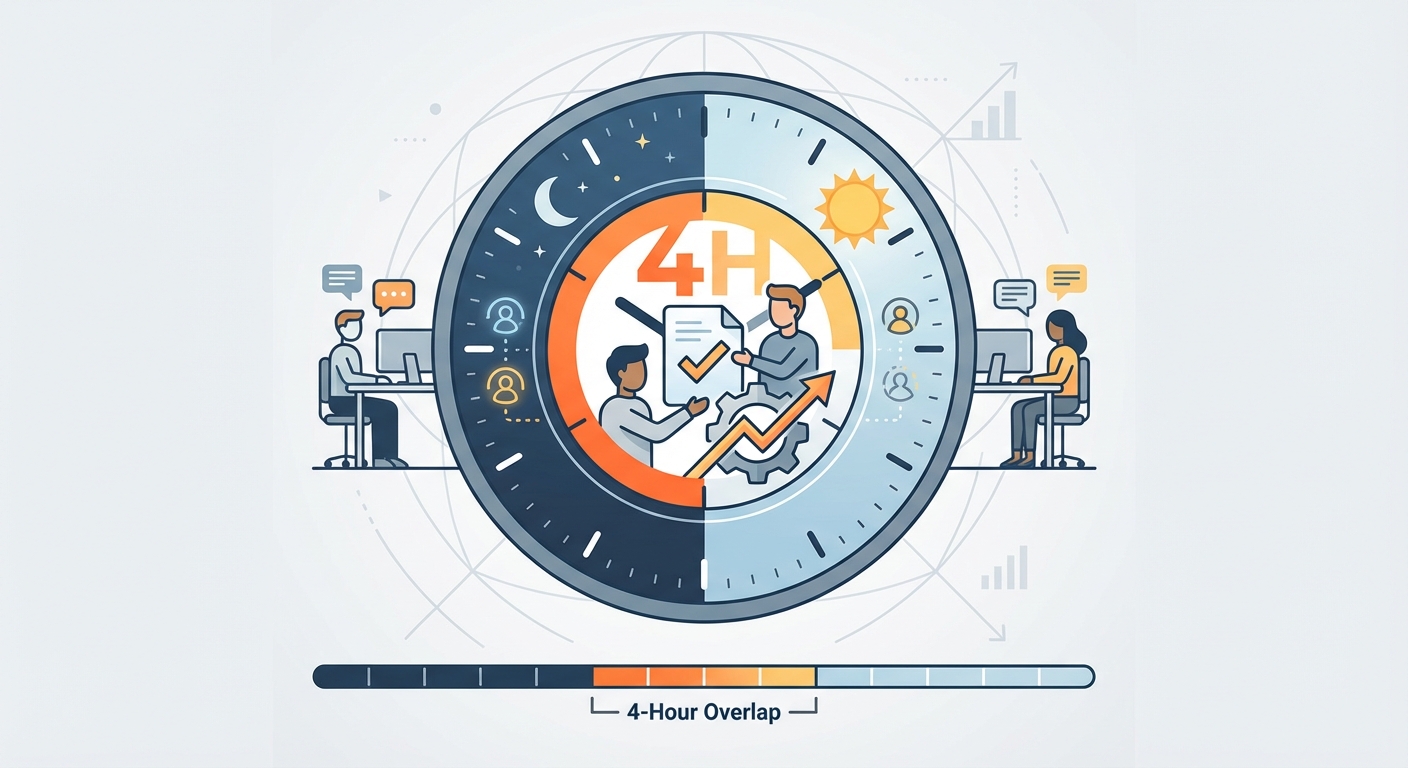
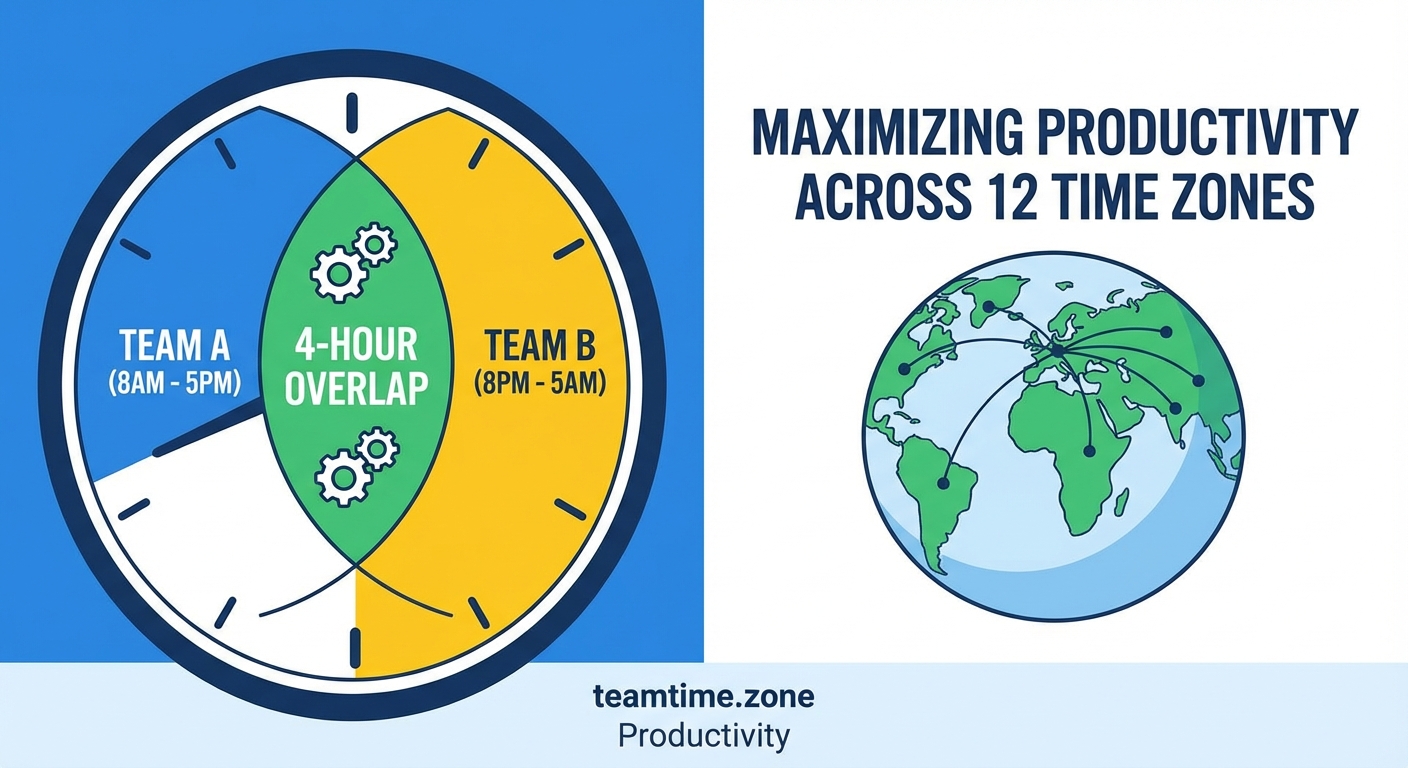
The four-hour overlap method focuses on identifying the maximum realistic overlap between your furthest time zones, then treating those hours as sacred. Not for status updates or information sharing. For decisions, problem solving, and relationship building.
Here’s how to implement it:
- Map every team member’s working hours in a shared calendar or timezone tool
- Identify the overlap window where at least 80% of the team can reasonably join
- Block that time for synchronous work only
- Move everything else to async channels
A development team I worked with had members in Manila, Warsaw, and Seattle. Their overlap was exactly 2 PM to 4 PM Warsaw time. Two hours, three times per week.
They used those six hours for pair programming sessions, architecture discussions, and team building. Everything else happened asynchronously through documented decisions and recorded updates.
Their sprint velocity increased 34% in two months.
Building an Async-First Communication Culture
Synchronous communication is expensive when managing teams across time zones.
Every real-time conversation excludes someone or forces someone to work outside their hours.
The alternative is building an async-first culture where the default is documentation, not discussion.
This doesn’t mean no meetings. It means meetings are the exception, not the rule.
Writing for Async Success
Async communication only works if people write clearly.
That means full context in every message. No “can we talk?” Slack messages. No vague emails that require three follow-ups.
A good async message includes:
* What decision or input you need
* All relevant background information
* Your recommendation or analysis
* A clear deadline for response
* What happens if there’s no response
Bad async: “Thoughts on the API design?”
Good async: “I’m proposing we use REST instead of GraphQL for the mobile API. The mobile team needs simpler caching and we don’t need the flexible querying. Draft spec is here [link]. Please review by Friday. If I don’t hear concerns, I’ll start implementation Monday.”
The second version respects everyone’s time and moves work forward without a meeting.
The Response Time Agreement
One of the biggest sources of friction in distributed teams is mismatched expectations about response time.
Someone in New York sends a message at 9 AM their time. They expect a response within an hour. But it’s 11 PM in Sydney.
Create explicit agreements about response times:
| Message Type | Expected Response | Channel |
|---|---|---|
| Urgent blocker | 2 hours during work hours | Direct message + phone |
| Decision needed | 24 hours | Project channel |
| FYI update | No response needed | Team channel |
| Discussion | 48 hours | Email or async thread |
Post this table in your team handbook. Reference it when people complain about “slow” responses.
Your Sydney developer isn’t being unresponsive. They’re asleep.
Meeting Strategies That Don’t Destroy Work-Life Balance
Some meetings are necessary when managing teams across time zones.
The key is making them count and distributing the pain fairly.
The Rotation Principle
If someone has to take a meeting at an inconvenient time, that burden should rotate.
This is non-negotiable for healthy distributed teams.
A common pattern is having the same people in Asia or Europe constantly join calls at 9 PM or 6 AM to accommodate US schedules. That’s a fast track to resentment and turnover.
Instead, implement meeting rotation. If your all-hands happens monthly, rotate the time so it’s convenient for different regions each month.
Month 1: 9 AM Pacific (good for Americas, rough for Asia)
Month 2: 6 PM Pacific (good for Asia, rough for Americas)
Month 3: 2 PM Pacific (compromise for everyone)
Rotating meeting times signals that you value everyone’s time equally.
The Recording Rule
Every meeting that spans time zones should be recorded.
No exceptions.
This serves two purposes. First, people who couldn’t attend can watch later. Second, it forces meeting organizers to make meetings worth recording.
If a meeting isn’t worth recording and sharing, it probably shouldn’t be a meeting.
One engineering director I know implemented a simple rule: any meeting without a recording and written summary within 24 hours gets automatically canceled next time it’s scheduled.
Meeting quality improved dramatically.
Async Standups Replace Daily Syncs
Daily standup meetings are a relic of co-located teams.
They make no sense when managing teams across time zones.
The solution is async standups where team members post updates in a shared channel or tool at the start of their day.
Format it simply:
* Yesterday: What I completed
* Today: What I’m working on
* Blockers: What’s stopping me
Everyone reads updates when they start work. Questions and offers of help happen in threads.
This gives you the visibility of a standup without forcing anyone into a 6 AM call.
Tools That Make Timezone Management Possible
You can’t manage a distributed team with just Slack and Google Calendar.
You need timezone-aware tools that prevent scheduling disasters.
Calendar Tools That Understand Time Zones
The biggest source of meeting confusion is timezone conversion errors.
Someone schedules a meeting for “3 PM” and half the team shows up at the wrong time because they didn’t specify which timezone.
Use scheduling tools that respect time zones and automatically show meeting times in each person’s local time.
Tools like Calendly, SavvyCal, or World Time Buddy prevent the “wait, is that my 3 PM or your 3 PM?” conversations.
Async Communication Platforms
Slack and email aren’t designed for async-first work.
They’re designed for real-time chat.
Consider tools like Twist, Basecamp, or Notion that structure conversations around topics instead of timestamps. This makes it easier to catch up on discussions without scrolling through hundreds of messages.
The tool matters less than the practice. What’s important is having a place where conversations can happen over 24 hours without anyone feeling left out.
Shared Timezone Displays
Put a world clock somewhere visible to your whole team.
This sounds basic, but it works.
When you can see that it’s 11 PM in Bangalore, you’re less likely to send that “just one small thing” message.
Some teams use physical world clocks in their home offices. Others use browser extensions or desktop apps that show team member timezones.
The constant visual reminder builds timezone empathy.
Common Mistakes That Kill Distributed Teams
Even experienced leaders make these errors when managing teams across time zones.
Mistake 1: Treating Overlap Hours Like Regular Hours
Your overlap window is precious. Don’t waste it on status updates or information sharing.
Those four hours when everyone can be online together should be reserved for collaborative work that genuinely benefits from real-time interaction.
Save the overlap for:
* Complex problem solving
* Brainstorming sessions
* Relationship building
* Difficult conversations
* Training and onboarding
Everything else can happen async.
Mistake 2: Assuming Everyone Works the Same Way
Different cultures have different work styles.
Some cultures prefer direct communication. Others value relationship building before business discussions. Some expect immediate responses. Others see that as disrespectful of boundaries.
Don’t impose one culture’s norms on a global team.
Instead, create explicit team agreements about how you’ll work together. Make the implicit explicit.
Mistake 3: Measuring Activity Instead of Results
When you can’t see people working, it’s tempting to track their activity.
How many messages did they send? How many commits did they make? When did they log in?
This is a trap.
Measuring activity in a distributed team creates perverse incentives. People optimize for looking busy instead of being effective.
Focus on outcomes instead. Did they complete the project? Did they solve the problem? Did they help the team move forward?
Trust your team to manage their own time. Judge them on their results.
“The best distributed teams I’ve worked with measured success by shipped features and solved problems, not by hours logged or messages sent. Once we stopped tracking activity and started tracking outcomes, both productivity and morale improved significantly.” – Remote engineering manager with 8 years of global team experience
The Follow-the-Sun Workflow Model
Some teams take timezone distribution and turn it into an advantage.
The follow-the-sun model passes work between time zones so that progress continues 24 hours a day.
Here’s how it works:
- Team A in Asia completes their portion of work and documents next steps
- Team B in Europe picks up where Asia left off, makes progress, documents
- Team C in Americas continues the work, documents, passes back to Asia
- Cycle repeats
This requires exceptional documentation and clear handoff processes.
But when it works, you get 24-hour productivity without anyone working overtime.
A customer support team I consulted for implemented this model across Manila, Dublin, and Denver. Their average ticket resolution time dropped from 18 hours to 6 hours because there was always someone working on urgent issues.
The key is treating handoffs as first-class work. Each team needs 30 minutes at the end of their day to document status, blockers, and next steps. The receiving team needs 30 minutes at the start of their day to review and ask questions.
Budget for this handoff time. It’s not overhead. It’s what makes the model work.
Building Connection Without Constant Meetings
The hardest part of managing teams across time zones isn’t the logistics.
It’s maintaining team cohesion when people rarely interact in real time.
Async Team Building
Team building doesn’t require everyone in the same room or even the same video call.
Create async activities that build connection:
- A shared photo channel where people post pictures from their daily life
- A “get to know you” thread where people answer fun questions throughout the week
- Collaborative playlists where team members add songs
- A virtual book club with async discussions
These create connection points without requiring synchronous time.
Intentional In-Person Gatherings
Even the most async-friendly teams benefit from occasional in-person time.
Budget for bringing the team together once or twice a year.
Don’t fill this time with status updates or work that could happen remotely. Use it for relationship building, strategic planning, and the kind of creative collaboration that’s harder to do async.
One fully distributed company I worked with brought their 40-person team together for a week every six months. They spent maybe 20% of the time on structured work sessions. The rest was informal collaboration, team activities, and relationship building.
That one week of in-person time made the next six months of remote work dramatically smoother.
Creating Shared Rituals
Rituals create team identity even when you’re not together.
This could be a weekly async video where different team members share what they’re working on. Or a monthly celebration thread where people share wins. Or a tradition of sending care packages to team members on their birthdays.
The specific ritual matters less than having something that’s consistently yours as a team.
When Timezone Distribution Doesn’t Work
Not every team should be distributed across 12 time zones.
Sometimes the coordination cost outweighs the benefits.
Projects that require constant real-time collaboration struggle with extreme timezone distribution. Early-stage startups that need to move fast and iterate constantly often do better with teams in closer timezones.
If you’re hiring for a distributed team, consider clustering in timezone regions:
- Americas cluster (US, Canada, Latin America)
- Europe/Africa cluster (GMT +/- 3 hours)
- Asia/Pacific cluster (GMT +7 to +10)
This gives you global coverage while maintaining 4-6 hours of overlap within each cluster.
You can still have a global team. You just organize it strategically instead of hiring purely based on talent location.
Making the Shift to Timezone-Aware Leadership
Managing teams across time zones requires different skills than managing co-located teams.
You need to be better at written communication. You need to trust more and micromanage less. You need to think in systems instead of moments.
The transition is uncomfortable.
You’ll feel less connected to your team at first. You’ll worry that you’re missing important information. You’ll be tempted to schedule “just one more meeting” to feel in control.
Resist that temptation.
The discomfort is temporary. The skills you build managing distributed teams make you a better leader overall.
Start small. Pick one meeting to replace with an async workflow. Implement response time expectations for your team. Try rotating one recurring meeting time.
Build the muscle gradually.
The Real Competitive Advantage of Global Teams
Here’s what most articles about managing teams across time zones miss.
Done right, timezone distribution isn’t a challenge to overcome. It’s a competitive advantage.
You get access to talent anywhere in the world. You can provide 24-hour customer coverage without shift work. You can move faster because work continues around the clock.
But only if you build the systems to support it.
The companies that figure this out will dominate their industries. The ones that try to force distributed teams into co-located patterns will struggle with turnover, burnout, and wasted talent.
Your choice is simple: adapt your management style to the reality of global teams, or watch your best people leave for companies that have.
The tools exist. The practices are proven. The only question is whether you’re willing to let go of the old playbook and build something better.
Your team in Sydney is starting their day. Your team in Berlin is wrapping up. Your team in San Francisco is just getting started.
And with the right systems, they’re all moving forward together.
Leave a Reply