Scheduling a meeting for a team spread across New York, London, and Singapore feels like solving a Rubik’s Cube blindfolded. Someone always ends up at 6 a.m. or 10 p.m., and the guilt compounds every time you send that calendar invite. The good news? You don’t need to sacrifice fairness or productivity to bring your distributed team together. You just need a system that respects everyone’s working hours and knows when to skip the meeting entirely.
Scheduling meetings across time zones requires rotating meeting times, finding overlap windows, and defaulting to asynchronous communication when possible. Use world clock tools, share the burden of inconvenient times fairly, and record every session. Most importantly, question whether you need the meeting at all before asking someone to wake up at 5 a.m.
Why Time Zones Break Traditional Meeting Habits
Most companies inherit meeting culture from the office era, when everyone sat in the same building and 2 p.m. worked for everyone. That assumption collapses the moment you hire someone in a different hemisphere.
The math is brutal. A 10 a.m. meeting in San Francisco lands at 6 p.m. in London and 2 a.m. in Sydney. No matter what time you pick, someone loses. And if you always pick the same time, the same people always lose.
This creates resentment, burnout, and a two-tiered team where some people get to attend live discussions while others read summaries the next morning. The solution isn’t finding a magical perfect time. It’s building a system that shares the pain and reduces reliance on synchronous meetings.
Find Your Team’s Overlap Windows
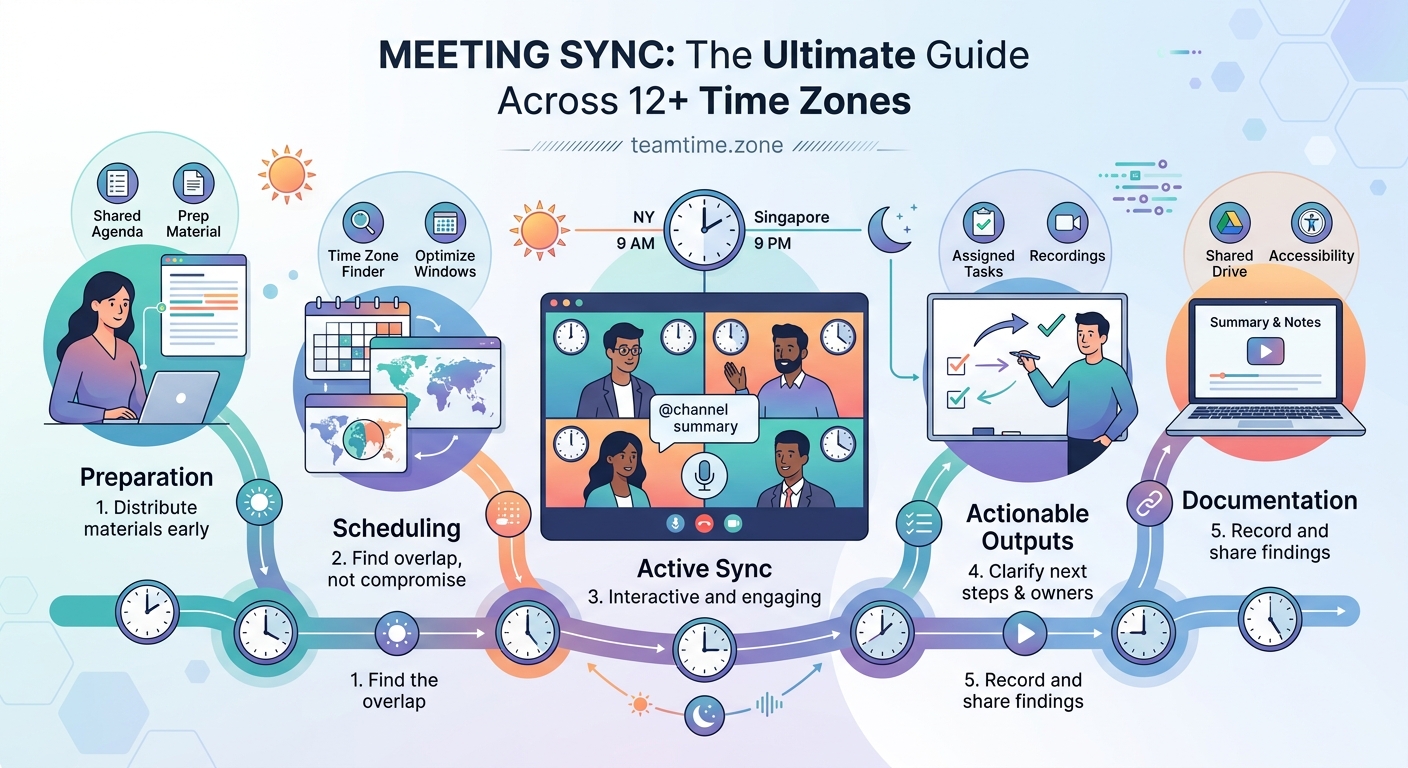
Before you schedule anything, map out when your team’s working hours actually intersect.
- List every team member’s working hours in their local time.
- Convert all hours to a single reference time zone (UTC works well).
- Identify the windows where at least 80% of the team is online.
You’ll often find a narrow band of two to four hours. For a team spanning California to Berlin, that might be 8 a.m. to 10 a.m. Pacific. For teams across Asia and Europe, it might not exist at all.
If you have zero overlap, you need to rotate meeting times or move to asynchronous workflows. No overlap means no fair meeting time exists.
Rotate Meeting Times to Share the Burden
If your team spans more than six time zones, someone will always take a hit. Make sure it’s not always the same person.
Rotation strategies that work:
- Alternate between two times that favor different regions (one month favors Americas, next month favors APAC).
- Use a three-meeting rotation if you have three major regions.
- Let team members opt out of meetings outside their working hours and watch the recording instead.
Document the rotation schedule publicly. Put it in your team wiki, pin it in Slack, and add it to meeting descriptions. Transparency prevents the perception of favoritism.
“We rotate our all-hands between 7 a.m. Pacific and 5 p.m. Pacific every other week. Nobody loves it, but everyone appreciates that we’re trying to be fair.” – Remote team lead at a SaaS company
Use the Right Tools to Avoid Timezone Math Errors

Humans are terrible at timezone arithmetic. Use tools that do the conversion for you.
Essential tools for distributed scheduling:
- World clock apps that show your team’s current local times at a glance.
- Calendar tools that automatically convert meeting times to each participant’s timezone.
- Scheduling assistants that find overlap windows and suggest fair times.
When you send a calendar invite, double-check that it displays correctly in each recipient’s timezone. A 9 a.m. meeting should show as 9 a.m. Pacific in one calendar and 5 p.m. GMT in another. If it doesn’t, your tool isn’t handling timezones properly.
Avoid writing meeting times in Slack or email as “9 a.m. my time” or “3 p.m. EST.” Always include the timezone abbreviation and consider adding a link to a timezone converter for clarity.
Default to Async Communication First
The best way to schedule meetings across time zones is to not schedule them at all.
Most meetings can be replaced with:
- Recorded video updates
- Shared documents with comment threads
- Async standups that collect status updates asynchronously
- Decision documents that gather input over 24 to 48 hours
Asynchronous work respects everyone’s schedule and often produces better results. People have time to think, research, and craft thoughtful responses instead of reacting in real time.
Reserve synchronous meetings for work that genuinely requires live discussion: brainstorming, conflict resolution, relationship building, and complex negotiations. Everything else can happen asynchronously.
Building an async-first communication culture takes intentional effort, but it pays dividends for distributed teams.
Record Every Meeting and Share Notes
If someone can’t attend live, they need a way to catch up. Recording meetings and sharing detailed notes ensures nobody falls behind.
Best practices for meeting recordings:
- Start recording before the meeting officially begins to capture early arrivals.
- Upload recordings to a shared location within an hour of the meeting ending.
- Add timestamps for key topics so people can skip to relevant sections.
- Include written notes alongside the video for people who prefer reading.
Make recordings searchable. Use transcription tools that generate text versions of the conversation. This helps people find specific information without watching an entire hour-long recording.
Never make attendance mandatory if you’re recording. Trust people to decide whether they need to attend live or can catch up later.
Set Clear Agendas and Pre-Read Materials
When you do schedule a synchronous meeting, make every minute count. People joining at inconvenient times deserve a meeting that’s worth their sacrifice.
Send the agenda at least 24 hours in advance. Include:
- Specific topics and time allocations for each
- Pre-read materials or background context
- Expected outcomes or decisions
- Who needs to attend live versus who can review the recording
Pre-reads let people prepare regardless of timezone. Someone in Tokyo can review materials during their morning even if the meeting happens during their evening.
Collect questions and input before the meeting starts. Use a shared document where people can add comments asynchronously. This surfaces issues early and makes the live meeting more efficient.
Common Mistakes and Better Alternatives
| Mistake | Why It Fails | Better Approach |
|---|---|---|
| Always scheduling at the same time | Same people always suffer | Rotate meeting times monthly |
| Assuming everyone can attend live | Creates resentment and exclusion | Make recordings mandatory, attendance optional |
| Scheduling back-to-back across timezones | No buffer for timezone confusion | Add 15-minute buffers before and after |
| Using ambiguous time references | “9 a.m.” means different things to different people | Always include timezone abbreviations |
| Making decisions in chat during others’ night | People wake up to fait accompli | Document decisions asynchronously with input windows |
Respect Cultural and Religious Calendars
Time zones aren’t the only scheduling consideration for global teams. Religious holidays, national celebrations, and cultural norms affect availability too.
Before scheduling recurring meetings:
- Check major holidays in all regions where your team works
- Ask team members about religious observances that affect their schedule
- Be aware of different weekend patterns (Friday/Saturday in some Middle Eastern countries, Sunday/Monday in parts of Asia)
- Respect local norms around work-life boundaries
A Friday afternoon meeting might seem fine to someone in New York but lands right at the start of Shabbat for an observant Jewish team member in Tel Aviv. A Monday morning meeting might conflict with a national holiday in Canada or India.
Keep a shared calendar of team holidays and observances. Update it annually and reference it before scheduling important meetings.
Know When Synchronous Meetings Are Actually Worth It
Not every meeting justifies waking someone up at 5 a.m. or keeping them online at 9 p.m.
Situations where synchronous meetings add real value:
- Building relationships with new team members
- Resolving conflicts that need tone and nuance
- Brainstorming sessions where ideas build on each other rapidly
- Crisis response that requires immediate coordination
- Negotiations with external parties who expect live discussion
Situations that work better asynchronously:
- Status updates and progress reports
- Routine project check-ins
- Information sharing or announcements
- Feedback collection
- Decision-making with clear options and criteria
Knowing when async doesn’t work helps you make intentional choices about meeting format instead of defaulting to synchronous by habit.
Create Explicit Communication Norms
Ambiguity kills distributed teams. Spell out exactly how your team handles timezone-related communication.
Document answers to these questions:
- What’s the expected response time for messages? (Hint: it should be measured in hours or days, not minutes.)
- When should someone schedule a meeting versus send an async update?
- How do you indicate urgency without implying someone should respond outside working hours?
- What happens if someone misses a meeting due to timezone conflicts?
Put these norms in writing during onboarding. New hires shouldn’t have to guess whether a Slack message at 11 p.m. their time requires an immediate response.
Setting clear response time expectations prevents burnout and respects boundaries across timezones.
Use Timezone Differences as an Advantage
Time zones aren’t just obstacles. They’re also opportunities for around-the-clock productivity.
Smart teams use timezone distribution to:
- Provide customer support coverage across 24 hours without night shifts
- Hand off work at end-of-day so the next timezone can continue progress
- Get faster feedback loops by routing questions to whoever is currently online
- Run continuous integration and testing cycles that span multiple regions
A bug reported by the New York office at 5 p.m. can be fixed by the Bangalore team during their morning and deployed before New York wakes up. A design review started in London can collect feedback from San Francisco the same day.
This requires intentional handoff processes and clear documentation, but it turns timezone spread from a liability into an asset.
Build Timezone-Specific Rituals
Not every team activity needs to include everyone. Sometimes smaller, timezone-specific gatherings build stronger connections.
Consider creating:
- Regional coffee chats or social hours at reasonable local times
- Timezone-specific retrospectives or planning sessions
- Buddy systems that pair people in similar timezones
- Regional channels for casual conversation
These smaller gatherings reduce isolation for team members who rarely get to attend live all-hands meetings. They also acknowledge that not every conversation needs global participation.
Balance timezone-specific activities with occasional all-team events. Maybe once a quarter, you schedule a meeting that rotates to favor different regions, and you make it special enough that people are willing to join outside normal hours.
Test Your Scheduling System Regularly
What works for a team of 12 might break when you reach 50. What works across three timezones might fail when you add a fourth.
Every quarter, audit your meeting practices:
- Who’s consistently missing live meetings due to timezone conflicts?
- Are recordings actually being watched, or are people falling behind?
- Has the rotation schedule become unfair as team composition changed?
- Are people working outside their stated hours to accommodate meetings?
Collect feedback anonymously. People might not volunteer that they’re joining meetings at 6 a.m. every week if they think it makes them seem less committed.
Adjust based on what you learn. The goal isn’t perfection. It’s continuous improvement toward a system that respects everyone’s time.
Making Global Collaboration Actually Work
Scheduling meetings across time zones will never be effortless. There’s no perfect time that works for everyone, and no tool that eliminates the fundamental challenge of coordinating across a rotating planet.
But you can build systems that share the burden fairly, respect people’s boundaries, and default to asynchronous work whenever possible. You can record everything, document decisions clearly, and create space for people to contribute regardless of when they’re online.
The teams that do this well don’t obsess over finding the perfect meeting time. They obsess over questioning whether the meeting is necessary at all. And when it is, they make sure it’s worth someone’s 6 a.m. wake-up call.
Start by mapping your team’s overlap windows, setting up a rotation schedule, and moving three recurring meetings to asynchronous formats this month. Your team will thank you, especially the ones who’ve been quietly joining calls at midnight for the past six months.