Your customers in Sydney wake up with urgent questions while your San Francisco team sleeps. By the time your US support agents clock in, those customers have already switched to a competitor who answered in minutes, not hours.
This isn’t a staffing problem. It’s a coverage problem. And the follow the sun support model solves it by passing work across time zones like a relay race, ensuring someone is always awake and ready to help.
The follow the sun support model distributes customer service teams across multiple time zones to provide 24/7 coverage during normal business hours. Instead of night shifts or on-call rotations, work moves from region to region as the sun rises. This approach reduces response times, prevents burnout, and scales global support without sacrificing team health or customer satisfaction.
What the follow the sun support model actually means
The follow the sun support model is a staffing strategy where you distribute teams across different geographic regions to maintain continuous operations. As one team finishes their workday, another team in a different time zone picks up where they left off.
Think of it like a relay race where the baton is a support ticket, a bug fix, or a customer inquiry.
Your London team handles European customers from 9am to 5pm GMT. As they log off, your New York team starts their day and takes over. Eight hours later, your Manila or Sydney team begins their shift and keeps the cycle running.
No one works nights. No one gets pulled out of bed for emergencies. Everyone works during daylight hours in their local time zone.
This model differs from traditional 24/7 support, which often relies on graveyard shifts, rotating schedules, or skeleton crews working overnight. Those approaches burn people out fast. The follow the sun model treats time zones as an asset, not an obstacle.
Why companies adopt this model
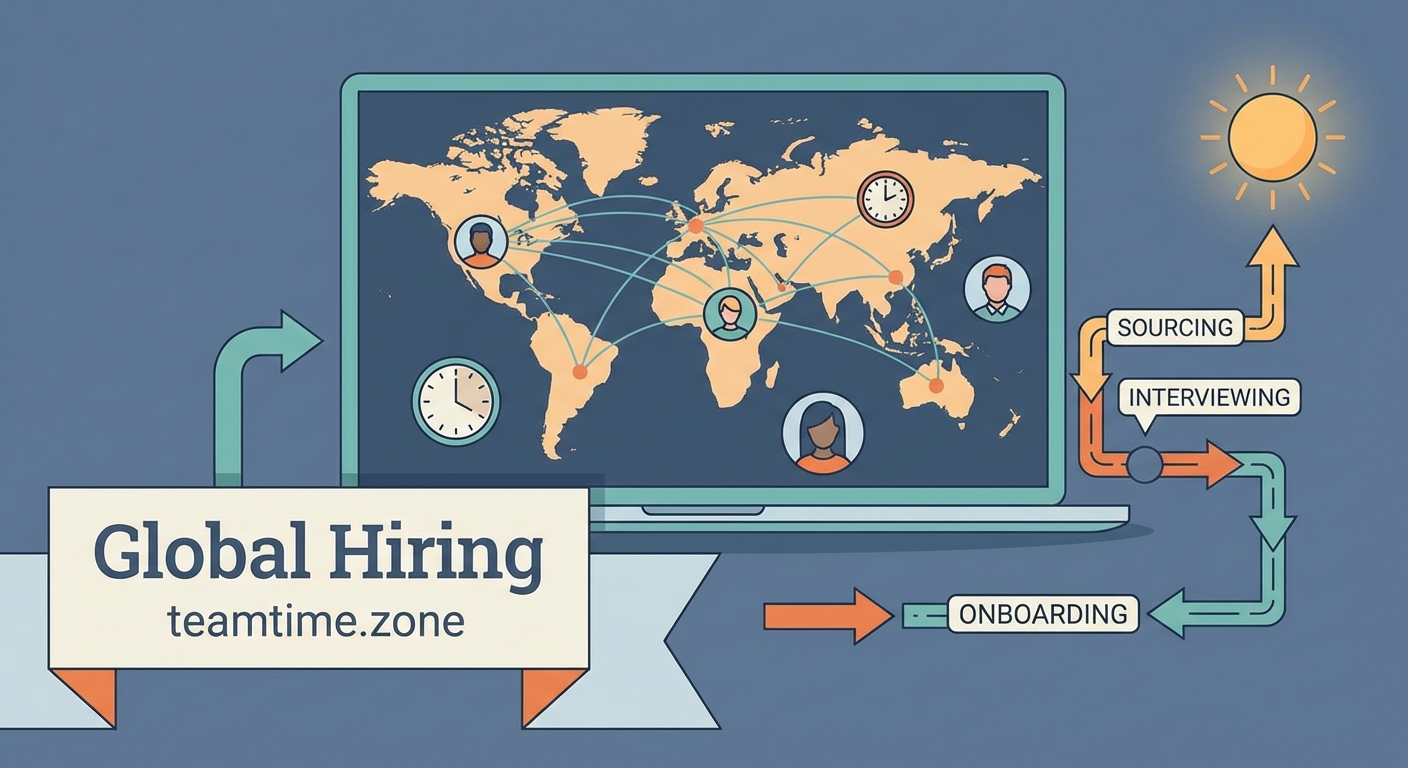
The follow the sun support model solves three core problems that plague global businesses.
Faster response times. When a customer in Tokyo submits a ticket at 10am local time, they don’t wait 12 hours for your US team to wake up. Your Asia-Pacific team responds immediately because it’s their normal working hours.
Better work-life balance. Your support agents work standard daytime hours. They sleep at night. They see their families. Burnout drops. Retention improves. You stop losing good people to exhaustion.
Scalable global coverage. As your customer base grows internationally, you can add teams in new regions without forcing existing teams to stretch their hours. Your coverage expands naturally with your market.
Companies like Atlassian, Microsoft, and IBM have used this model for years to support millions of users across every continent. It’s not a new idea, but it’s becoming essential as remote work normalizes and customer expectations for instant support rise.
Core principles that make it work
The follow the sun support model only works if you build it on solid foundations. Here are the non-negotiable principles.
Standardized processes across all regions
Every team must follow the same playbook. If your Manila team uses different ticketing workflows than your Dublin team, handoffs become chaotic. Customers get contradictory answers. Tickets fall through cracks.
Document everything. Create shared knowledge bases. Use the same tools and templates globally. When a ticket moves from one region to another, the receiving team should understand the context immediately without hunting for information.
Clear handoff protocols
The moment when one team passes work to the next is where most follow the sun models fail. You need structured handoffs that include:
- Summary of what was done during the shift
- Outstanding issues that need attention
- Priority items flagged for immediate action
- Context notes for complex cases
Some teams use a shared async standup format to document handoffs. Others rely on detailed ticket updates. The method matters less than consistency.
Overlap windows for real-time collaboration
Even in an async-first model, you need some overlap between regions. A one or two hour window where teams can communicate in real time makes handoffs smoother and builds relationships across time zones.
Your New York team might start at 8am EST while your London team works until 6pm GMT, creating a two-hour overlap. Use this time for questions, clarifications, and collaborative problem-solving.
Unified visibility into all work
Everyone needs to see the same dashboard, ticket queue, and status updates regardless of location. If your Singapore team can’t see what your Toronto team worked on yesterday, you’re setting them up to duplicate effort or miss critical updates.
Invest in tools that provide real-time visibility across regions. Shared Slack channels, unified ticketing systems, and centralized documentation platforms are non-negotiable.
When this model makes sense for your business
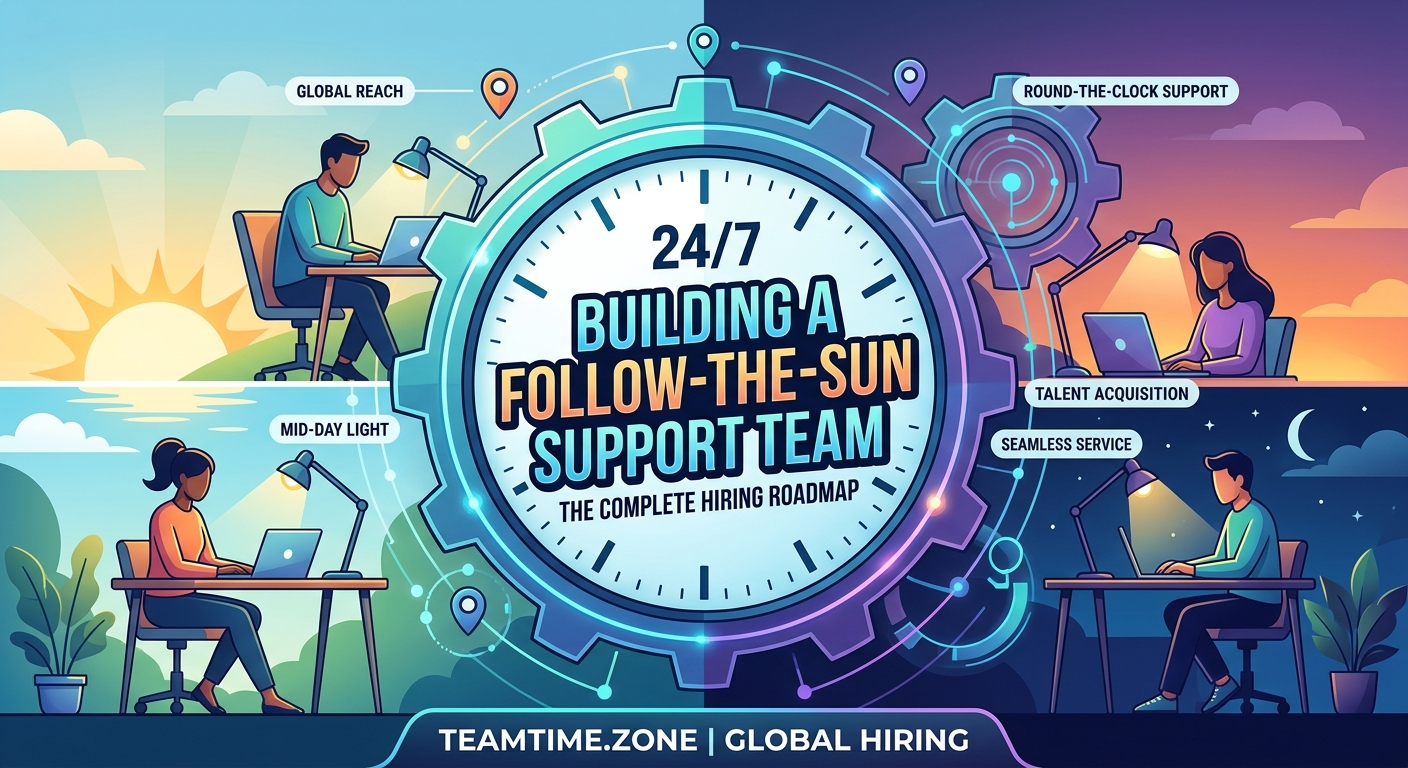
The follow the sun support model isn’t right for every company. It requires significant investment in hiring, tooling, and process design. Here’s when it makes sense.
You have customers in multiple continents. If 80% of your customers live in one time zone, you don’t need global coverage. But if you serve Europe, Asia, and the Americas equally, response time expectations demand it.
Your product requires fast support. If you sell enterprise software where downtime costs customers thousands per hour, you can’t make them wait until morning. Financial platforms, healthcare systems, and infrastructure tools often need this level of coverage.
You’re growing internationally. If your roadmap includes expanding into new markets, building follow the sun coverage early prevents scrambling later. It’s easier to add a third region when you already have two running smoothly.
Your team is already distributed. If you’ve hired remote workers across multiple time zones, you’re halfway there. You just need to formalize the handoff process and fill coverage gaps strategically.
How to implement the model step by step
Building a follow the sun support operation takes planning. Here’s the practical roadmap.
1. Map your current coverage gaps
Pull your support ticket data for the last six months. Identify when tickets come in and how long customers wait for first response.
You’ll likely see patterns. Maybe Asian customers wait 12 hours on average because your US team is asleep. Maybe European customers get great morning coverage but struggle in the afternoon.
These gaps tell you where to hire next.
2. Choose your regional hubs strategically
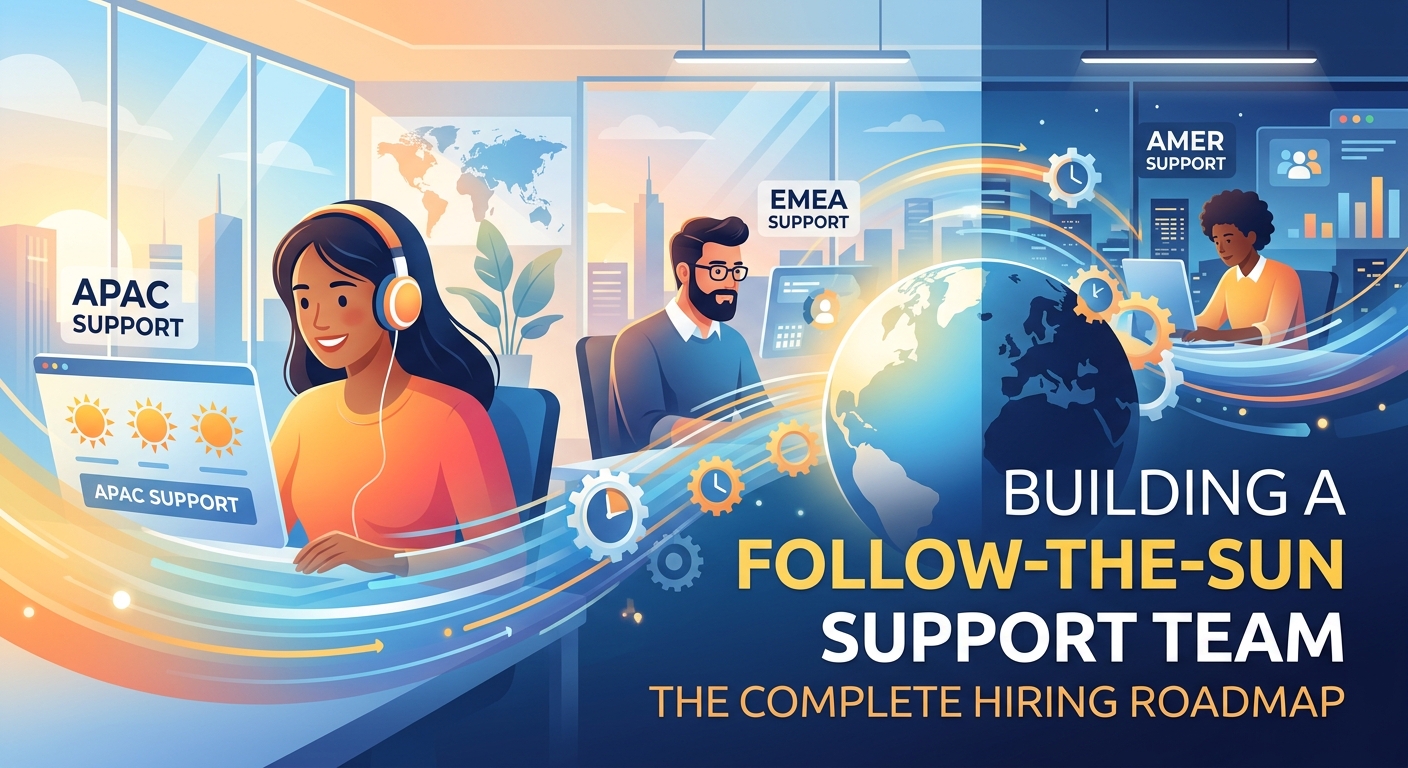
You don’t need teams in every time zone. Three well-placed hubs can provide 24-hour coverage.
A common setup:
- Americas hub: US East Coast or Latin America
- Europe/Africa hub: UK, Ireland, or Central Europe
- Asia-Pacific hub: India, Philippines, or Australia
Each hub covers roughly eight hours. The overlap between regions handles edge cases.
Consider labor costs, language requirements, and talent availability when choosing locations. Manila offers strong English fluency and lower costs. Dublin provides EU timezone coverage with native English speakers. Pick what aligns with your budget and customer base.
3. Hire for timezone coverage, not just skill
When you recruit for follow the sun teams, timezone becomes a key qualification. You’re not just hiring a support engineer. You’re hiring someone who can work 9am to 5pm in a specific region.
This changes your recruiting strategy. You might pass on an excellent candidate in the wrong timezone and hire a slightly less experienced person in the right one. That’s not settling. It’s strategic.
Use job postings that specify required working hours clearly. Screen candidates based on their ability to maintain consistent schedules in their local timezone.
4. Standardize your tools and workflows before day one
Don’t wait until your second or third region is onboarded to standardize processes. Build the playbook first.
Choose one ticketing system. One knowledge base platform. One communication tool. Train every new hire on the same workflows from day one.
If you’re starting from scratch, tools like Zendesk, Intercom, or Freshdesk work well for ticketing. Notion or Confluence handle documentation. Slack or Microsoft Teams manage real-time communication.
The specific tools matter less than ensuring everyone uses the same stack. Fragmentation kills follow the sun models faster than any other mistake.
5. Create a handoff ritual that happens every single day
At the end of each region’s workday, they should complete a handoff checklist:
- Update all active tickets with current status and next steps
- Flag urgent items that need immediate attention
- Post a summary in the shared team channel
- Tag the incoming team on anything that needs real-time discussion
Some teams schedule a 15-minute overlap call during handoff windows. Others rely entirely on written updates. Both work if done consistently.
The key is making handoffs non-negotiable. They can’t be skipped when someone is busy or forgot. Build them into your daily workflow as a required step before logging off.
6. Measure response times by region and customer timezone
Track how long customers wait for first response based on when they submitted the ticket and where they’re located.
If customers in Japan wait twice as long as customers in California, your Asia-Pacific coverage isn’t working. If European customers get great service but African customers don’t, you might need to adjust your EMEA team’s hours.
Break down metrics by region, not just globally. Aggregate data hides problems.
Common mistakes that break the model
Even well-intentioned teams make these errors when implementing follow the sun support.
| Mistake | Why it happens | How to fix it |
|---|---|---|
| Treating one region as the “main” team | The first team hired sets all the standards | Give every region equal authority over processes and documentation |
| Skipping documentation during busy periods | Teams prioritize closing tickets over writing updates | Make documentation a required step in the ticket workflow, not optional |
| Hiring too fast without training capacity | Leadership wants coverage immediately | Onboard one region at a time with dedicated training resources |
| Allowing timezone bias in promotions | Leadership is usually in one timezone and promotes people they see online | Create explicit policies for preventing timezone bias in advancement |
| Using synchronous tools for async work | Teams default to Zoom and Slack because it feels faster | Build an async-first communication culture with written updates as the default |
Building team cohesion when you never overlap
One of the hardest parts of the follow the sun model is building relationships between people who rarely work at the same time.
Your Manila team and your Boston team might never be online together. How do you create trust and camaraderie?
Record everything. When your team solves a tricky problem, record a Loom video explaining the solution. Share wins in async updates. Make your work visible even when you’re offline.
Rotate overlap windows occasionally. Once a month, ask your Manila team to join a call at 8pm their time so they can meet the Boston team in real time. Rotate who makes the sacrifice so no one region always works odd hours.
Create shared goals that cross regions. Instead of regional performance metrics, track global team performance. When the entire follow the sun operation hits a milestone, celebrate together.
Use async team building. You can’t do happy hours across 12 time zones, but you can run async team building activities that let people participate on their own schedule.
What to do when handoffs fail
Even with perfect processes, handoffs will occasionally break down. Someone gets sick. A ticket gets missed. A customer falls through the cracks.
Here’s how to recover.
Build redundancy into your system. Never rely on one person to complete a handoff. Have at least two people per region who can handle the end-of-day summary.
Use automated alerts for aging tickets. If a ticket hasn’t been updated in six hours, the system should ping the current region’s team lead. This catches forgotten items before they become emergencies.
Conduct weekly handoff reviews. Spend 30 minutes each week reviewing handoff quality. Look for patterns. Did the APAC to EMEA handoff fail three times this week? Why? Fix the root cause, not just the symptom.
Document failures openly. When a handoff breaks, write a post-mortem. Share it with all regions. Treat it as a learning opportunity, not a blame session.
“The best follow the sun teams treat handoff failures as system problems, not people problems. If one person forgetting to update a ticket breaks your entire operation, your process is too fragile.” – Operations director at a global SaaS company
Scaling beyond three regions
Once you have three regions running smoothly, you might consider adding a fourth or fifth to provide even tighter coverage or serve specific customer segments.
Before you do, ask yourself:
- Do we have coverage gaps that genuinely hurt customers, or are we just trying to be perfect?
- Can we improve handoffs between existing regions instead of adding more?
- Will a new region generate enough ticket volume to keep a full team busy?
Adding regions too aggressively creates overhead. More handoffs mean more opportunities for mistakes. More teams mean more coordination complexity.
Only scale when customer data proves you need it. If your Asia-Pacific team is overwhelmed and customers in that region wait too long, add capacity there before opening a new region.
Making the model work long term
The follow the sun support model isn’t a set-it-and-forget-it system. It requires ongoing maintenance.
Review your coverage quarterly. Customer distribution changes. Your Australian customer base might double while European growth slows. Adjust team sizes and hours to match reality.
Invest in team leads for each region. You need someone in each timezone who can make decisions without waiting for approval from headquarters. Empower regional leads to solve problems locally.
Rotate people between regions occasionally. If someone from your US team spends a month embedded with your Manila team, they build empathy and understanding that improves collaboration forever. Make these rotations optional but encouraged.
Keep documentation obsessively up to date. Outdated playbooks are worse than no playbooks. Assign someone to review and update core documentation monthly.
Celebrate wins globally. When your Manila team solves a customer crisis at 2am Boston time, make sure Boston knows about it. Recognition across time zones builds culture.
When your team spans the entire day
The follow the sun support model transforms time zones from a liability into a competitive advantage. Your customers get help when they need it. Your team works reasonable hours. Your business scales globally without breaking people.
But it only works if you treat it as a system, not just a staffing strategy. Invest in the handoffs. Standardize the processes. Build the culture. Measure the outcomes.
Start small. Add one region. Perfect the handoffs. Then add another. You don’t need global coverage on day one. You need sustainable coverage that grows with your business.
Your customers will notice the difference. So will your team.