Trust feels harder to build when your team exists in Slack channels and Zoom squares instead of shared office space. You can’t read body language over coffee. You can’t gauge reactions during hallway conversations. And yet, trust remains the foundation of every high-performing team, remote or not.
The good news? Distance doesn’t have to mean disconnection. Teams scattered across continents can build stronger trust than colocated teams who share the same floor. It just requires different tactics.
Building trust in remote teams requires intentional communication, transparent decision-making, and consistent follow-through. Success comes from creating predictable patterns, documenting everything, respecting time zones, and fostering genuine human connection through structured interactions. Trust grows when team members feel heard, valued, and informed regardless of their location or schedule.
Why Trust Breaks Down When Teams Go Remote
Trust erodes in remote settings for specific, fixable reasons.
First, the absence of casual interactions removes natural relationship-building moments. No lunch conversations. No spontaneous desk visits. No Friday afternoon team celebrations.
Second, asynchronous communication creates information gaps. When someone doesn’t respond immediately, minds fill the silence with assumptions. “Are they ignoring me?” “Did I say something wrong?” “Do they not care about this project?”
Third, timezone differences make collaboration feel unfair. Team members in minority timezones attend meetings at 6 AM or 10 PM while others enjoy convenient midday slots. Resentment builds when the same people always sacrifice sleep.
Fourth, lack of visibility breeds suspicion. When you can’t see someone working, doubt creeps in. “Are they actually productive?” “Are they pulling their weight?”
These challenges are real. But they’re not insurmountable.
The Foundation Blocks Every Remote Team Needs
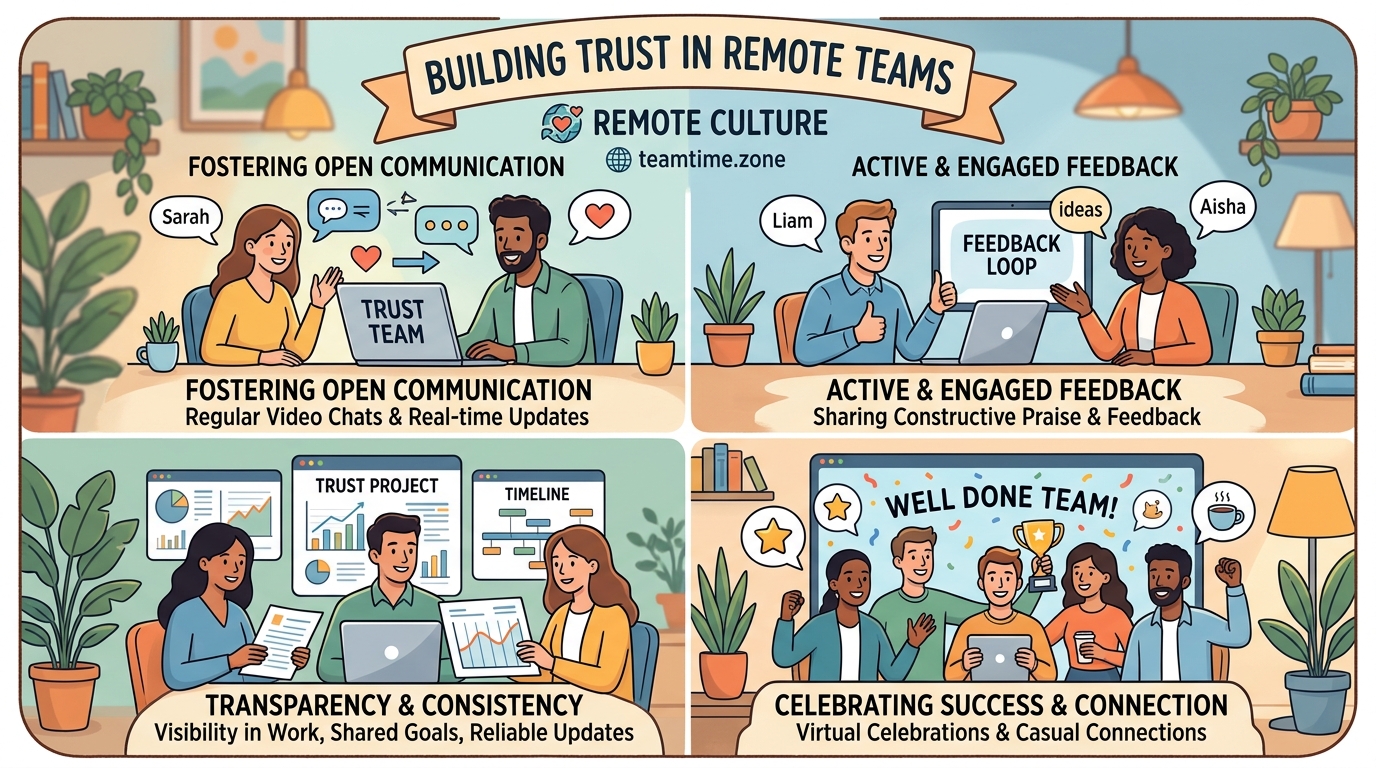
Before implementing specific trust-building tactics, establish these baseline practices.
Create communication norms everyone understands
Document how your team communicates. Specify which tools serve which purposes. Define expected response times for different channels. Clarify when synchronous meetings are necessary versus when async communication works better.
Make information accessible
Trust crumbles when people feel left out of important conversations. Create a single source of truth for decisions, updates, and context. Use shared documents, wikis, or project management tools where anyone can find what they need without asking.
Respect time zones systematically
Don’t just acknowledge timezone differences. Build systems that honor them. Rotate meeting times so burden gets shared. Record important sessions. Use scheduling tools that visualize timezone overlaps instead of forcing everyone to do mental math.
Set clear expectations
Ambiguity kills trust remotely. Be explicit about deadlines, deliverables, quality standards, and communication preferences. When someone knows exactly what success looks like, they can deliver it.
Seven Practical Strategies That Actually Work
Here’s how to build genuine trust across distributed teams.
1. Document decisions in writing, always
Verbal decisions made in meetings create confusion and exclusion. When three people discuss something on a call and make a choice, the other seven team members lose context.
Instead, document every decision with:
- What was decided
- Why this choice was made
- Who was involved
- What alternatives were considered
- When this takes effect
This practice builds trust in three ways. It shows respect for people who couldn’t attend. It creates accountability. And it prevents the “I thought we agreed on something different” conflicts that damage relationships.
Proper decision documentation becomes your team’s institutional memory.
2. Share context, not just tasks
Assigning work without explanation feels transactional. “Do this by Friday” doesn’t build trust. It creates compliance at best, resentment at worst.
Instead, share the why behind every request:
- How does this task connect to larger goals?
- What problem does it solve?
- Who benefits from this work?
- What happens if we don’t do it?
When people understand the bigger picture, they feel trusted with important information. They make better decisions. They take more ownership.
3. Run structured check-ins that go beyond status updates
Regular async standups keep everyone aligned, but they shouldn’t just track task completion.
Add questions that surface blockers, concerns, and needs:
- What’s unclear right now?
- What decision are you waiting on?
- What would make your work easier this week?
- Where do you need help?
These questions signal that you care about more than output. You care about the person behind the work.
4. Celebrate wins publicly and specifically
Recognition builds trust when it’s genuine, specific, and public.
Don’t just say “Great job on the project.” Say “The way you restructured the onboarding flow reduced customer confusion by 40%. That directly solved the problem we’ve been struggling with for months.”
Specific praise shows you’re paying attention. Public recognition shows you value contribution. Both build trust.
5. Admit mistakes and model vulnerability
Leaders who pretend to be perfect create cultures where everyone hides problems.
When you make a mistake, own it publicly:
- “I missed the deadline I committed to. That delayed the entire team. I’m sorry.”
- “I made the wrong call on that vendor. Here’s what I learned and how we’ll fix it.”
- “I didn’t communicate clearly, which caused confusion. Let me clarify.”
This vulnerability gives others permission to be honest about their own challenges. Trust grows when people can talk about problems without fear.
6. Create dedicated space for non-work connection
Trust needs human connection, not just professional interaction.
Create optional channels or meetings for:
- Sharing weekend plans or hobbies
- Posting photos of pets, kids, or home offices
- Discussing shared interests like books, sports, or cooking
- Playing online games together
- Celebrating personal milestones
Make these truly optional. Forced fun destroys trust. But providing space for organic connection helps people see each other as whole humans, not just coworkers.
7. Follow through on commitments, every time
Nothing builds trust faster than reliability. Nothing destroys it faster than broken promises.
If you say you’ll do something, do it. If circumstances change and you can’t, communicate proactively. Don’t wait for someone to ask.
Track your commitments. Set reminders. Build systems that prevent things from falling through the cracks.
When team members learn they can count on you, they extend the same reliability to others.
The Trust-Building Communication Matrix
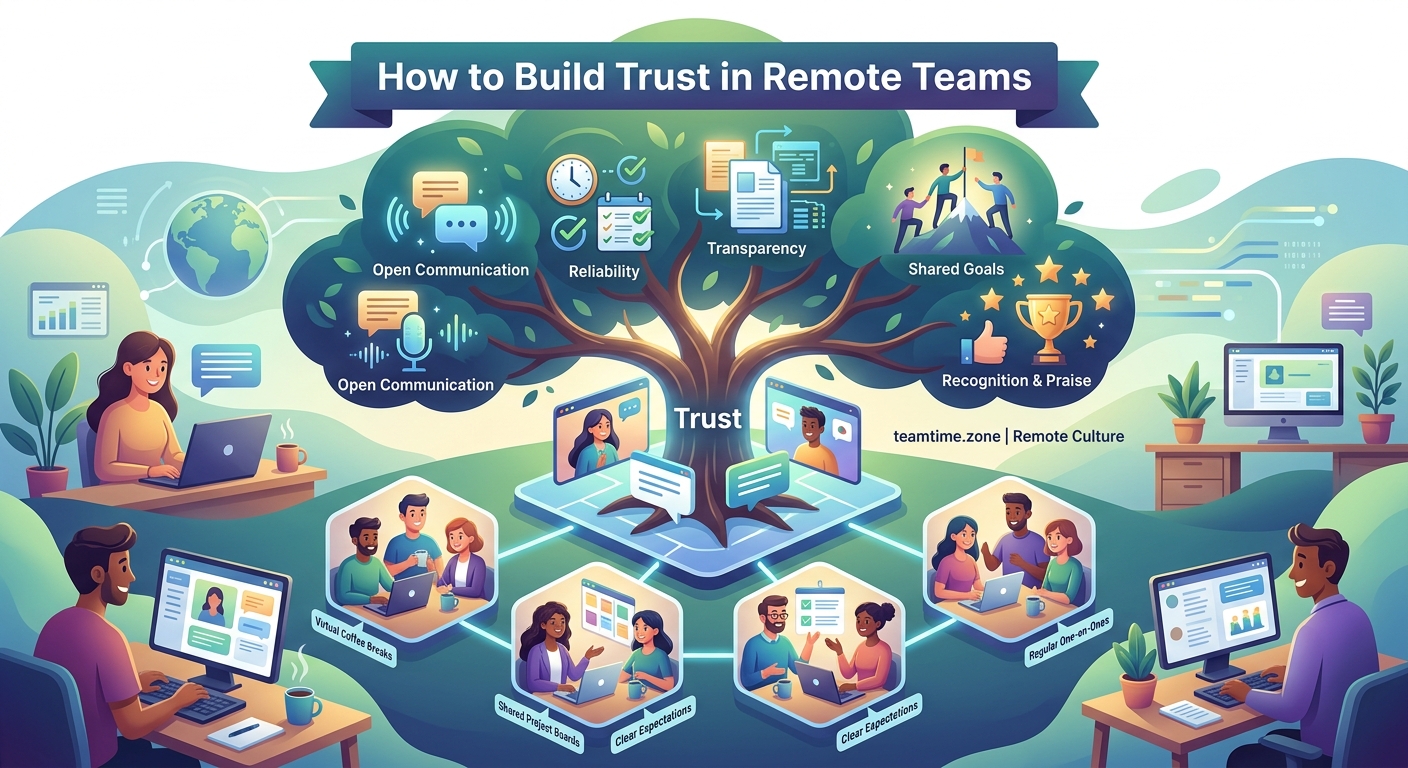
Different communication methods serve different trust-building purposes. Here’s how to match the method to the goal.
| Communication Goal | Best Method | Why It Works |
|---|---|---|
| Share decisions | Written documentation | Creates transparency and inclusion |
| Gather input | Async threads with deadlines | Gives everyone time to think and contribute |
| Resolve conflict | Video call (recorded) | Allows nuance while maintaining record |
| Build relationships | Optional social channels | Enables organic connection without pressure |
| Give feedback | Written first, then discussion | Provides time to process before reacting |
| Make announcements | Video message + written summary | Combines personal touch with reference material |
| Brainstorm ideas | Collaborative documents | Allows parallel contribution across timezones |
| Celebrate wins | Public channels with specifics | Maximizes visibility and impact |
What Destroys Trust in Remote Teams
Avoid these common mistakes that erode trust faster than you can build it.
Holding important conversations in private channels
When decisions happen in DMs or small group chats, excluded team members feel like outsiders. They wonder what else they’re missing. Paranoia grows.
Keep conversations in public channels unless there’s a genuine privacy need.
Ignoring timezone inequity
Scheduling all meetings during one timezone’s business hours tells some team members their time matters less. This creates resentment that poisons trust.
Micromanaging through surveillance tools
Tracking mouse movements or screenshot monitoring signals deep distrust. You can’t build trust while simultaneously broadcasting that you don’t trust people.
Focus on outcomes, not activity.
Responding inconsistently
When you reply to some messages in minutes and ignore others for days, people feel devalued. Unclear response time expectations create anxiety and frustration.
Changing direction without explanation
Pivots happen. But when priorities shift without context, team members feel jerked around. They stop investing energy because they assume things will change again anyway.
Playing favorites with visibility
When the same people always get highlighted while others’ contributions go unnoticed, trust fractures. Recognition should be equitable and merit-based.
Building Trust Through Better Meetings
Meetings can build or destroy trust depending on how you run them.
Use this checklist for trust-building meetings:
- Share the agenda 24 hours in advance so people can prepare meaningful contributions
- Start with personal check-ins that give everyone a voice before business begins
- Rotate meeting times when your team spans multiple continents
- Record everything and share recordings with written summaries for those who couldn’t attend
- End with clear action items assigned to specific people with specific deadlines
- Follow up in writing within 24 hours with decisions and next steps
Proper meeting recordings ensure nobody gets left behind due to timezone challenges.
The Role of Transparency in Remote Trust
Transparency means sharing information proactively, not just answering questions when asked.
Create transparency through:
Open roadmaps that show what’s coming and why priorities are set
Visible metrics that let everyone see how the team and company are performing
Accessible calendars so people know when you’re available and when you’re not
Public decision logs that explain why choices were made
Honest updates about challenges, not just successes
“In remote teams, trust grows in proportion to information shared. When people have context, they make better decisions. When they lack context, they make assumptions. Assumptions rarely favor trust.”
Measuring Trust on Your Remote Team
You can’t improve what you don’t measure. Track these indicators of team trust:
- Response rates to requests for input (Low participation signals low trust)
- Time to surface problems (Long delays mean people fear speaking up)
- Voluntary knowledge sharing (Hoarding information indicates distrust)
- Participation in optional activities (Engagement shows psychological safety)
- Feedback quality in retrospectives (Honest critique requires trust)
- Cross-functional collaboration (Silos suggest territorial behavior)
Run quarterly anonymous surveys asking:
- Do you feel informed about important decisions?
- Can you be honest about challenges without fear?
- Do you believe your contributions are valued?
- Do you trust your teammates to follow through?
- Do you understand how your work connects to team goals?
When Trust Is Already Broken
Sometimes you inherit a team where trust has already eroded. Rebuilding requires different tactics than building from scratch.
Acknowledge the problem directly
Don’t pretend everything is fine. Name the trust issues explicitly. “I know there’s been inconsistent communication in the past. That changes now.”
Make small promises and keep them
Don’t commit to massive overhauls. Start with tiny, achievable promises. Deliver on those consistently. Trust rebuilds through accumulated reliability.
Create new patterns
Old habits triggered distrust. Establish completely new routines that signal change. New meeting formats. New communication channels. New decision-making processes.
Give it time
Broken trust doesn’t heal in a week. Expect months of consistent behavior before people truly believe things have changed.
Trust as a Remote Team Superpower
Remote teams that crack the trust code outperform colocated teams in surprising ways.
They make faster decisions because people don’t second-guess each other’s motives. They solve problems more creatively because diverse perspectives get heard. They retain talent longer because people feel genuinely valued.
Trust turns timezone differences from obstacles into advantages. When you trust your teammate in Singapore to make good decisions, you get 24-hour productivity cycles. When you trust your teammate in Berlin to represent the team well, you expand your reach.
The distance that seems like a trust barrier actually becomes a trust amplifier. Because when trust exists without physical proximity, it’s deeper and more resilient than trust built on casual hallway chats.
Start with one strategy from this guide. Document your next decision. Share context with your next task assignment. Celebrate someone’s specific contribution today.
Trust builds one action at a time. And in remote teams, those actions need to be more intentional, more visible, and more consistent than ever before. But the payoff is worth it.