
Your team in Tokyo just logged off for the day. Your designer in Berlin is eating lunch. Your developer in San Francisco hasn’t had coffee yet. And you need everyone on a call tomorrow.
Managing meetings across time zones turns every scheduling decision into a puzzle where someone always loses. The engineer takes calls at 7 PM. The marketer wakes up at 5 AM. The product manager misses dinner with their family three nights a week. Left unchecked, this pattern doesn’t just hurt morale. It destroys it.
Successful global teams rotate meeting inconvenience fairly, default to asynchronous communication, and establish clear overlap windows. The goal isn’t finding one perfect time slot. It’s building a system where no single person or region carries the scheduling burden every week. Fair distribution of inconvenience, combined with strong async practices, keeps distributed teams productive without burning anyone out.
Why Time Zone Differences Break Teams
The damage isn’t obvious at first. You schedule one early call for the West Coast team. Then another late meeting for the Asia-Pacific crew. Before long, someone’s attending meetings at midnight while others join at dawn.
This creates three problems.
First, it concentrates the pain. The same people sacrifice their evenings or mornings repeatedly. Resentment builds. Performance drops.
Second, it normalizes bad boundaries. When late-night meetings become routine, people stop protecting their personal time. They answer Slack messages at 11 PM. They check email before breakfast. Work bleeds into everything.
Third, it excludes people from decisions. If your weekly planning call happens at 3 AM Sydney time, your Australian team members can’t participate meaningfully. They watch recordings. They miss context. They feel like second-class contributors.
The solution isn’t finding a magical time slot that works for everyone. That slot doesn’t exist when your team spans eight or more time zones.
The solution is building a system that distributes inconvenience fairly and reduces dependence on synchronous meetings altogether.
The Foundation: Async-First Operations
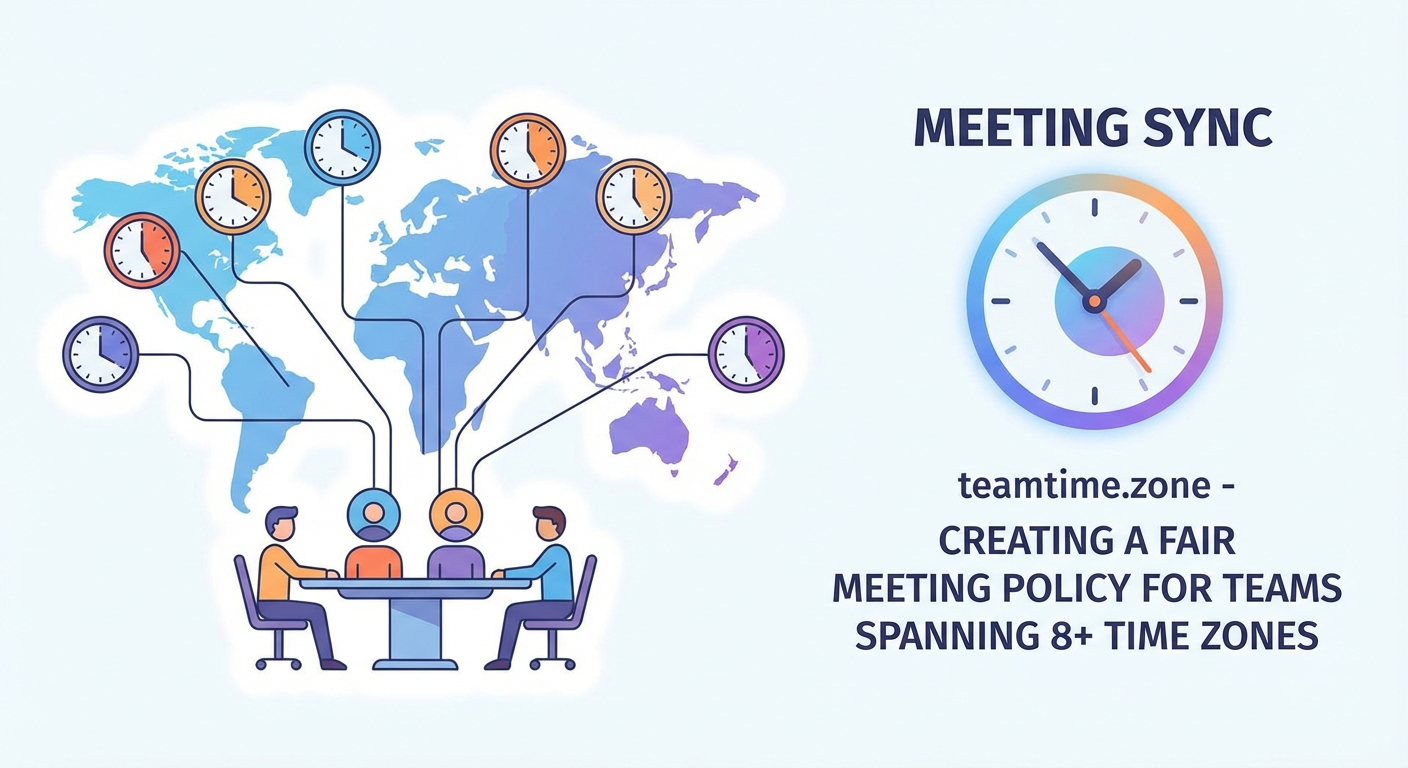
Before you worry about scheduling meetings, ask whether you need the meeting at all.
Most information sharing doesn’t require real-time discussion. Status updates work better as written summaries. Project kickoffs can happen through recorded videos. Decision documentation belongs in shared documents, not meeting notes.
Building an async-first communication culture means defaulting to asynchronous methods and only scheduling synchronous time when truly necessary.
Here’s what actually requires live meetings:
- Brainstorming sessions where ideas build on each other rapidly
- Conflict resolution between team members
- Sensitive feedback conversations
- Complex negotiations with multiple stakeholders
- Emergency response coordination
Everything else can happen asynchronously.
Replace daily standups with async status updates. Turn weekly check-ins into Loom videos. Transform planning meetings into collaborative documents with comment threads.
This doesn’t mean eliminating meetings completely. It means reserving synchronous time for discussions that genuinely benefit from real-time interaction.
The Rotation System That Actually Works
When you do need meetings, rotate the inconvenience systematically.
Here’s a simple three-step rotation framework:
-
Map your time zones. List every team member’s location and working hours. Identify which regions have zero overlap, partial overlap, or full overlap.
-
Create rotation blocks. Divide recurring meetings into three-week or four-week blocks. Week one favors Americas-friendly times. Week two favors Europe and Africa. Week three favors Asia-Pacific. Week four (if using four-week blocks) finds a compromise time where everyone shares the pain equally.
-
Communicate the pattern. Make the rotation schedule visible in your team calendar. People can plan their lives around predictable inconvenience. Unpredictable late meetings hurt more than scheduled ones.
This approach prevents the scenario where your Singapore team always takes 9 PM calls while your New York team always meets at 10 AM.
“Fairness in distributed teams isn’t about equal treatment. It’s about equitable distribution of sacrifice. Everyone should feel the time zone pain proportionally.”
Some teams resist rotation because it means leadership occasionally takes inconvenient time slots. That’s exactly the point. When managers experience the same scheduling pain as individual contributors, they make better decisions about meeting necessity.
Finding Your Overlap Windows
Even with rotation, you need to identify realistic overlap periods.
Here’s how to calculate working overlap between distant time zones:
| Team Locations | Overlap Window | Best Use |
|---|---|---|
| US West Coast + Europe | 8 AM Pacific / 5 PM Central European | Brief syncs only, max 30 minutes |
| US East Coast + Asia Pacific | 7 PM Eastern / 8 AM next day Singapore | Early evening US, morning APAC |
| Europe + Asia Pacific | 8 AM Singapore / 1 AM Central European | Requires rotation, no natural overlap |
| Americas + Europe + Asia | None sustainable | Must rotate or split into regional meetings |
When your overlap window is narrow, protect it fiercely.
Block core overlap hours for collaborative work, not status updates. Use that precious shared time for activities that genuinely require everyone present simultaneously.
The 3-hour window rule suggests that if your team’s overlap is three hours or less, you should limit synchronous meetings to one hour maximum per day during that window.
The rest of the workday belongs to focused individual work and asynchronous collaboration.
Tools That Respect Time Zones
Your calendar tool matters more than you think.
Standard calendaring creates problems because it doesn’t clearly show time zone context. Someone in London schedules a “9 AM meeting” and your San Francisco team sees 1 AM without realizing the organizer didn’t check their local time.
Meeting scheduling tools that respect time zones solve this by displaying multiple time zones simultaneously and flagging unreasonable hours.
Essential features to look for:
- Automatic time zone detection and conversion
- Visual indicators for out-of-hours scheduling
- Team availability overlays showing everyone’s working hours
- Meeting time suggestions that consider all participants’ locations
- Calendar integrations that preserve time zone data
World Time Buddy and similar tools help you visualize overlap. Google Calendar and Outlook both support multiple time zone displays. Calendly can block off unreasonable hours automatically.
But tools only help if you establish clear policies about when meetings can happen.
Setting Boundaries That Stick
Good intentions aren’t enough. You need explicit rules.
Define your team’s meeting boundaries in writing:
- No recurring meetings before 8 AM or after 6 PM in any team member’s local time
- Exceptions require manager approval and must be rotated
- Emergency meetings (production incidents, critical client issues) are exempt but must be followed by async summaries
- Meeting recordings and notes must be posted within two hours
- Attendance is optional for meetings outside someone’s working hours
Make these rules visible. Put them in your team handbook. Reference them when scheduling. Enforce them consistently.
The most important boundary is this: normalize saying no to meetings that violate these rules.
When someone schedules a 10 PM call for your Sydney team member without rotation justification, that team member should feel empowered to decline and suggest an alternative.
The Recording and Documentation Standard
Every meeting that crosses time zones must be recorded and documented thoroughly.
This isn’t optional. It’s how you include people who couldn’t attend live.
Your documentation standard should include:
- Full video recording with searchable transcript
- Written summary of decisions made (not just discussion points)
- Action items with owners and deadlines
- Links to relevant documents or resources mentioned
- Clear next steps
Post these materials within two hours of the meeting ending. Longer delays mean people in other time zones start their workday without critical information.
Document decisions asynchronously so people can catch up and contribute even if they missed the live discussion.
Good documentation also lets you audit whether meetings were necessary. If the recording gets three views and no comments, that meeting probably should have been an email.
Common Mistakes That Kill Distributed Teams
Most time zone management failures follow predictable patterns.
| Mistake | Why It Hurts | Better Approach |
|---|---|---|
| Same people always accommodate | Breeds resentment, causes burnout | Rotate systematically |
| Meetings scheduled ad-hoc | Unpredictable, prevents planning | Use consistent time slots |
| No async alternative provided | Excludes people from decisions | Record everything, enable comments |
| “Just this once” exceptions | Become regular occurrences | Enforce boundaries consistently |
| Forgetting about daylight saving | Creates confusion twice yearly | Use UTC references for clarity |
The “just this once” trap is particularly dangerous. You schedule one emergency meeting at 11 PM for someone. Then another urgent call. Then a “really important” client discussion. Before long, late meetings are normal.
Hold the line on exceptions. Real emergencies are rare.
When to Split Instead of Rotate
Sometimes rotation doesn’t solve the problem.
If your team spans 12+ time zones with no reasonable overlap, consider splitting meetings into regional sessions instead of forcing everyone into one call.
This works well for:
- Weekly team updates that are primarily information sharing
- Training sessions that can be delivered multiple times
- Planning meetings where regional teams have different priorities
- Social connection time meant to build relationships
Run the same meeting twice or three times. Post recordings and summaries so people can see what other regions discussed. Use asynchronous tools to synthesize decisions across regions.
Running meetings across 12+ time zones often means accepting that some discussions need to happen in stages rather than all at once.
The tradeoff is clear. You lose some spontaneity and cross-pollination of ideas. You gain sustainable working hours and better participation from each region.
Measuring Whether Your System Works
How do you know if your time zone management is actually fair?
Track these metrics:
- Distribution of inconvenient meeting times by person (meetings outside 9 AM to 5 PM local time)
- Meeting attendance rates by region
- Time from meeting end to documentation posted
- Number of async-first processes versus synchronous requirements
- Employee feedback on work-life balance
If your Tokyo team member has eight late meetings this month while your Boston team member has zero, your rotation isn’t working.
If attendance from your European team drops below 70%, they’re probably burned out on early or late calls.
If documentation consistently posts 24+ hours after meetings, people in other time zones can’t stay current.
Survey your team quarterly. Ask specifically about time zone fairness. Make adjustments based on feedback.
Building Culture Without Constant Meetings
The biggest fear about reducing synchronous time is losing team cohesion.
People worry that without regular video calls, distributed teams will feel disconnected. That relationships will suffer. That culture will evaporate.
This fear is based on a false premise. Culture doesn’t require constant meetings.
Building trust in remote teams happens through consistent communication, reliable follow-through, and creating space for human connection in whatever format works.
Strong async cultures build connection through:
- Dedicated Slack channels for non-work conversation
- Async video updates where people share personal stories
- Written team retrospectives where everyone contributes reflections
- Virtual coffee chats scheduled at mutually convenient times (not forced)
- Recognition and celebration that happens in writing, not just on calls
You can have one monthly all-hands meeting for the entire team, rotated fairly. You can have quarterly regional gatherings. You can have annual in-person meetups.
The rest of the time, you build culture through how you work together, not how often you meet.
Making the Transition
If your team currently runs on constant synchronous meetings, shifting to this model takes time.
Start here:
-
Audit current meetings. List every recurring meeting. Note attendees, time zones, and stated purpose.
-
Eliminate or convert. Cancel meetings that are purely informational. Convert status updates to async formats. Keep only meetings that require real-time discussion.
-
Implement rotation. For remaining meetings, create a rotation schedule. Communicate it clearly. Start next month.
-
Build async infrastructure. Set up documentation systems. Train people on async tools. Create templates for common communication needs.
-
Monitor and adjust. Check metrics monthly. Gather feedback. Refine your approach.
The first month will feel uncomfortable. People will miss the familiar rhythm of regular meetings. They’ll worry about missing information.
Stick with it. Within six weeks, most teams report higher productivity and better work-life balance.
Handling Special Cases
Some situations require modified approaches.
Onboarding new hires: New team members need more synchronous time initially. Schedule daily check-ins during their first two weeks, finding times that work for their location and their onboarding buddy. Reduce frequency after they’re settled.
Client-facing teams: External meetings can’t always be rotated. Compensate by giving client-facing team members more control over internal meeting schedules. If someone takes a 10 PM client call, they shouldn’t also have an 8 AM internal standup.
Project launches: Critical project phases might require temporary increases in synchronous time. Make these periods explicit and time-bound. Return to normal patterns once the launch completes.
Performance issues: Difficult conversations about performance should happen synchronously at a reasonable time for the person receiving feedback. Never deliver serious feedback through async channels or at someone’s 11 PM.
Knowing when to go synchronous is a skill that improves with practice.
Your Next Steps
Managing meetings across time zones isn’t about finding perfect solutions. It’s about building systems that distribute inconvenience fairly and minimize dependence on synchronous time.
Start with one change this week. Pick your most painful recurring meeting and either convert it to async or implement rotation. Document the change. Measure the impact.
Next week, tackle another meeting. Build momentum gradually.
Your team will thank you when they can eat dinner with their families, sleep normal hours, and still stay connected to important decisions. That’s what good time zone management delivers.
Leave a Reply